Adults in Aztec culture firmly believed in the divine control of childbirth and that, from the moment of conception, the healthy development of the fetus depended on the will of the gods. Aztec society was imbued with religious customs, yet it was also very practical, designing a series of systems to monitor the mother and her unborn child.
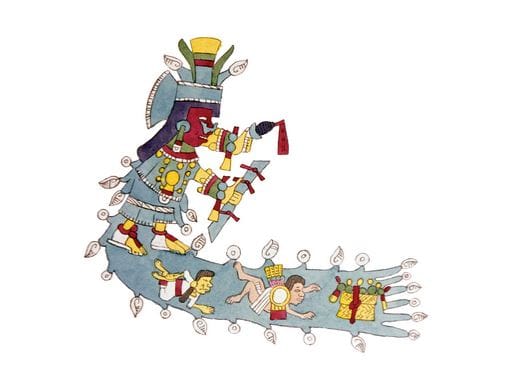
 Chalchiuhtlicue – meaning “She who wears a jade skirt” – was the Aztec goddess of rivers, lakes, and fresh water. She was also associated with infants and children and was believed to “wash away” the parents’ sins from the newborn.Ancient Wisdom of the Aztec Midwife
Much of what is known about Aztec society comes from the work created by Bernardino de Sahagún, a Spanish Franciscan who lived near what is now Mexico City. In the second half of the 16th century, Sahagún compiled an extensive collection of Aztec customs, and in the sixth book, he writes about the complex methods and rituals of childbirth among the Aztecs. The general history explanation focuses primarily on Aztec obstetrics, the tlamatlquiticitl or midwife. Women higher on the social ladder had access to a “team of midwives,” but even women lower on the social ladder had access to the services of an Aztec midwife.
The Tlamatlquiticitl – the Aztec midwife – regularly visited pregnant women in their homes where she performed gynecological examinations. If she detected anything unusual, she would place the pregnant woman in a tub and press on her abdomen to turn the baby if it was in the wrong position, moving it from one part to another.
For women who were pregnant for the first time, the Aztec midwife advised on diet and other habits, for example, making sure the bathwater was not too hot. She recommended sexual intercourse until the seventh month of pregnancy “because if she completely abstained from sexual relations, the baby would be born sick and weak.”
In her role as a mentor and “wise” confidante, the tlamatlquiticitl – the Aztec midwife – advised the expectant mother not to lift excessive weight, as this could endanger the fetus. She recommended that she “avoid sadness, anger, and surprises, so as not to harm the child or miscarry.”
As labor approached, the Aztec midwife stayed at the woman’s home for four or five days to prepare her for childbirth. The orderliness and cleanliness of Aztec society, which the Spanish immediately noticed upon arrival, also strongly influenced birth customs. The woman’s body, her hair, and the room where the birth took place were thoroughly cleaned. The Aztec midwife then prepared a steam bath in a temazcal. This was a type of sauna with aromatic plants, a low roof, and no smoke, located just outside the home. This relaxed the woman while the midwife checked the fetus’s condition. Aztec skill with herbal medicines greatly helped reduce trauma and pain during childbirth. When the woman began to experience contractions, the Aztec midwife could offer her cioapatli tea, an herb “that helped push the child out.” If the woman was still in pain or not dilating, they gave her “half a finger of the tail of an animal called tlacuatzin. Then she would give birth without difficulty.”

The woman in labor squatted with the Aztec midwife behind her, holding her heels, so that gravity would help push the baby out and reduce the mother’s effort. Sahagún excitingly notes that Aztec women gave birth with much less effort and pain than Spanish women and recovered so quickly that they soon became pregnant again. During a solar eclipse, pregnant women in Aztec society remained indoors.
First Days of Life in Aztec Society
After birth, the Aztec midwife checked the hygiene of the mother and newborn. First, she took the mother back to the temazcal sauna to excrete toxins from her body through sweat. Molds and aromatic plants relaxed the woman and helped her begin milk production. Babies were washed so that Chalchiuhtlicue, the aforementioned goddess of water, would “cleanse their hearts and make them good and pure.”
After childbirth, the Aztec midwife stayed for another four days to monitor the baby’s care with breast milk. Weaning did not occur until the child was two years old, as the Aztecs had no animals whose milk could be used as a substitute. During these four days, the Aztec midwife performed many practical tasks alongside pious rituals. The placenta was buried in a corner of their home. If the newborn was a boy, his umbilical cord was given to a warrior, who buried it in enemy territory, and because Aztec men were mostly warriors, they believed this ritual imbued them with strength and courage.
Soon after birth, the Aztecs recited passages from the Huehuetlatolli, a collection of sayings, speeches, and advice from their elders, including words of welcome with which the midwife and grandparents greeted the newborn, such as: “Your skill is war; your task is to offer the sun the blood of your enemies, so it may drink and nourish the earth, Tlaltecuhtli, with the bodies of enemies.” If a girl was born, her umbilical cord was buried by the fireplace to make her a good wife and mother. She was called to be “for the home what the heart is for the body.”

The newborn naming ceremony was a key ritual in Aztec society. It was the father’s duty to inform the priests of the day and time of birth, who then consulted the Tonalamatl, a ritual calendar (260 days), to determine the most suitable name. The purpose of this, according to Sahagún’s records, was “to predict the child’s fortune or misfortune, based on the characteristics of the sign under which they were born.” The Aztecs perceived the last five days of the year as bad, so parents did everything to ensure that children born on these days were named after this period ended.

From Cradle to Grave
Despite the care provided during pregnancy, birth was often fatal. If the mother died during childbirth, she was treated as a warrior who died in battle. She was buried in a special temple at dusk, and her soul traveled to the house of the sun.
If the fetus was stillborn, the midwife took a knife made of stone called itztli, cut the dead body inside the mother, and removed it piece by piece, a “horrific procedure that served to save the mother from death. The Aztecs believed that children who died during childbirth traveled to a place called Chichiualcuauhco, where surrogate mothers fed them milk. There they remained until the gods sent them to be born from another mother, and the cycle of birth and death turned once more.”