Fathers represent the primary source of support for breastfeeding mothers. Mothers often identify the father of their child as important in making decisions about breastfeeding. There is not much scientific research addressing the role of fathers in breastfeeding.
Recent research shows that when a father has a positive attitude toward breastfeeding, is involved in breastfeeding decisions, and provides support (psychological, practical, physical, etc.), this greatly influences the decision and persistence in breastfeeding among nursing mothers. The father’s influence is associated with increased breastfeeding rates in women and longer breastfeeding duration, with some studies citing positive effects on decisions regarding breastfeeding initiation, continuation, and weaning (Binns and Scott, 2002; Earle, 2002; Sherriff et al., 2009; Swanson and Power, 2005). On the other hand, excluding the father from breastfeeding support and preparation can have a negative impact on the father’s quality of life, self-efficacy, and self-image.
Certain studies (Abu-Abbas and I Kassab and I Shelash, 2016) show that in some (conservative) environments, fathers have a negative, dismissive attitude toward breastfeeding due to environmental and societal influences, religion, and stereotypes. Consequently, they do not want to be involved in breastfeeding and support, and the breastfeeding mother lacks a primary pillar of support during this important life process.
Elsewhere, fathers face a lack of knowledge for providing help. In some places, fathers express clear interest in collaborating with their partners and supporting them in breastfeeding. However, they feel they lack the knowledge, understanding, and skills to provide adequate support and help (Brown and Davies, 2014). Thus, the study highlights the importance of greater information and support regarding breastfeeding, which should be directed not only to breastfeeding mothers but also to fathers or partners.

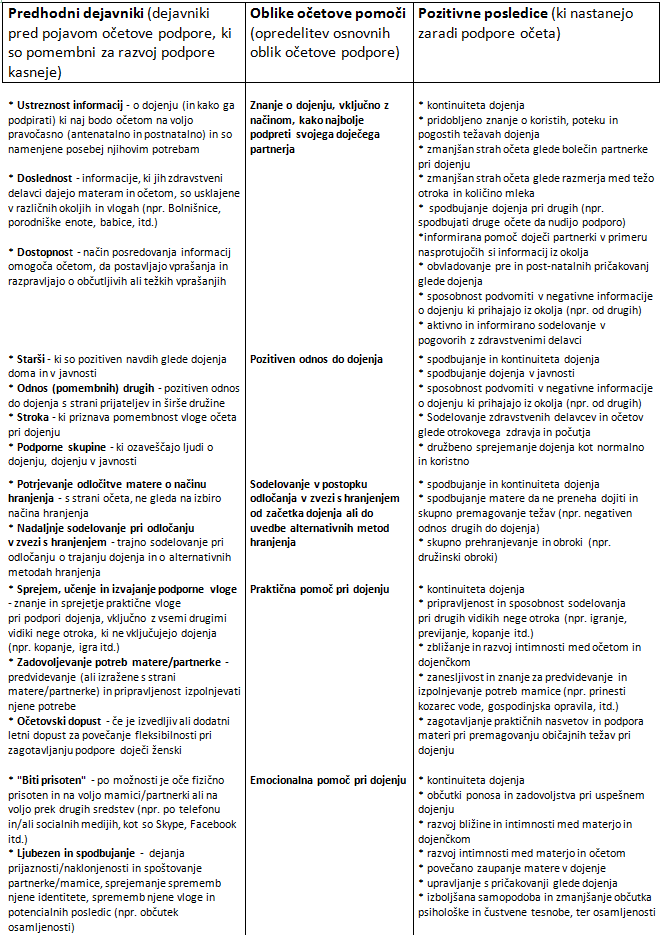
Table: Antecedent factors, forms of father’s help, and consequences of father’s support in relation to breastfeeding continuation (Sheriff et al., 2014)
We can conclude that involving fathers in the preparation process and support for breastfeeding positively affects breastfeeding, bonding with the partner, and strengthening the newly formed family. In midwifery and nursing, it would also be necessary to encourage the presence and role of the father throughout the entire breastfeeding process and beyond, and to provide fathers with relevant information so they can more easily offer breastfeeding support. For midwifery students, nursing students, and others, the concept can serve as a foundation for further research, not only because there is little research in this area but also because it is an interesting and current topic.
Source1, Source2, Source3, Source4, Source5
Paternity Leave
Paternity leave is leave intended for fathers to participate with the mother in caring for and looking after the child from the earliest days.
The right to paternity leave belongs to the child’s father and is non-transferable.
Regardless, if the father has not used paternity leave, it can be used under the same conditions by:
- another person and the mother’s spouse, the mother’s unmarried partner, and the partner of a registered same-sex partnership who actually cares for and looks after the child,
- the spouse, unmarried partner, or partner of a registered same-sex partnership of the person using maternity leave.
When claiming the right to paternity leave, you must be aware:
- no later than the day before starting paternity leave (after the child’s birth), report to the social work center where the mother claimed the right to maternity leave or where her right to maternity leave was recognized; you can also print the application form here,
- no later than 30 days before the planned start of paternity leave, notify your employer of your intention to use the leave.
In 2017, the father is entitled to 50 calendar days of paternity leave. 25 calendar days of paternity leave are paid, as the state provides paternity allowance for them. For the remaining 25 calendar days, the state provides payment of social security contributions from the minimum wage.
The first 15 calendar days (or 11 working days) of leave must be used by the father by the child’s sixth month. From January 1, 2017, the father is entitled to an additional 10 calendar days of paid paternity leave, which must be used in a continuous block after the end of parental leave, but no later than the end of the child’s first grade of elementary school. The remaining 25 calendar days (or 17 working days), for which social security contributions are paid (so-called “unpaid” leave), can be used by the father until the child’s third year.
Right to paternity leave in 2017
- Up to 10 calendar days of paternity leave in a continuous block in 2017 are available to fathers of newborns who are applying for paternity leave for the first time.
- Up to 10 calendar days of paternity leave in a continuous block are available to fathers of children who are younger than three years and have not yet applied for 5 calendar days of paternity leave and have at least 50 calendar days (35 working days) of “unpaid” paternity leave remaining—they have not yet applied for it or have not yet used it. After January 1, 1. 2017, they can apply for 10 calendar days of paid paternity leave with an application. They will receive a new decision regarding the right, in which they will be entitled to 10 calendar days of paid paternity leave, which must be used in a continuous block (consecutively, including Saturdays, Sundays, and holidays) and 50 calendar days less of “unpaid” paternity leave, if it has already been granted to them.
- Up to 10 calendar days of paternity leave in a continuous block are available to fathers of children who are younger than three years and acquired the right to 5 paid days of paternity leave in 2016, but have not yet used them, and have at least 25 calendar days (17 working days) of “unpaid” paternity leave remaining. After January 1, 1. 2017, they can apply to convert the right to 10 calendar days of paid paternity leave. They will receive a new decision regarding the right, in which they will be entitled to 10 calendar days of paid paternity leave, which must be used in a continuous block (consecutively, including Saturdays, Sundays, and holidays) and 25 calendar days less of “unpaid” paternity leave.
- Up to 10 calendar days of paternity leave in a continuous block are available to fathers of children who are younger than three years and acquired the right to 5 paid days of paternity leave in 2016 and have already used them and have at least 25 days (17 working days) of “unpaid” paternity leave remaining. After January 1, 1. 2017, they can apply to convert the right to 10 calendar days of paid paternity leave. They will receive a new decision regarding the right, in which they will be entitled to 10 calendar days of paid paternity leave and 25 calendar days less of “unpaid” paternity leave. Since fathers have already used 5 calendar days and since the condition for use is a continuous block, which was interrupted here due to the gradual implementation of the right over several different years, they can only use 5 more days in a continuous block.
- Fathers who have already fully used “unpaid” paternity leave (they have less than 25 calendar or 17 working days remaining) and fathers whose children are older than three years at the time of application and can no longer claim or use “unpaid” paternity leave cannot convert “unpaid” paternity leave to paid.
Paternity leave is claimed at the social work center with an application. The center grants the right to paternity leave with a decision. In the application, it is not yet necessary to specify the dates of use for the 10 paid calendar days, which the father uses in a continuous block. After use, the father reports the dates to the social work center for allowance payment. Source, CDS Mb