Movement, or motor development, is crucial in early life for the development of all human functions (Sešek and Jereb, 2004). It is a process through which a child acquires motor skills and patterns, resulting from the interaction between genetic and environmental influences.
Every child is unique, developing at their own optimal pace and according to their abilities. The more opportunities an infant has to practice motor tasks, the better they will develop and become stronger. Therefore, they need time and an environment for exploration and object manipulation. According to many authors, the most we can do for a child’s motor development is to ensure natural motor development with an optimal environment and as little restriction as possible (Papalia et al., 2003).
For a healthy, full-term infant, it is understood that they go through known developmental stages. An infant’s movement begins spontaneously after birth with primitive reflexes. These begin to disappear as the infant gains a sense of learning motor tasks through interaction with the environment and is mature enough for it. Most primitive reflexes thus fade by the third month of the infant’s age. Simultaneously with spontaneous holistic movement, the development of voluntary movements begins at the end of the third week of age. Motor development proceeds in a specific sequence, i.e., from the center (trunk) of the body outwards and from the head downwards; it happens instinctively. In other words, the infant will first develop control of the trunk, then the head, and then the arms and legs. Smooth, targeted, and precise movements of fine and gross motor skills require coordinated functioning of sensory systems, the central nervous system, and the muscular system (Denckla, 1974).
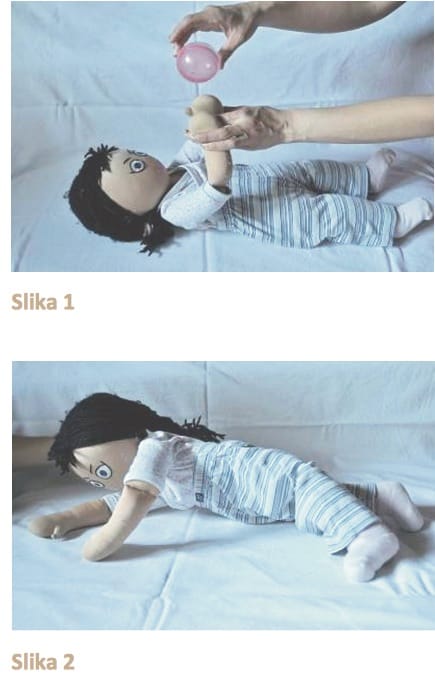
 Head control is the first motor task (Figure 1) that infants develop. In the first three months after birth, it is important for the infant to maintain a midline head position. Body symmetry is maintained in the supine position with both arms in the same position on both sides of the body. The neck is long. The chin touches the sternum. This is also a sign that the asymmetric tonic neck reflex is slowly disappearing. When lying on their back and lifting their legs upwards, we encourage them with a toy or our face to keep their head in the middle and establish eye contact. If we move the toy to the side, they will follow it with their gaze and “accidentally” turn onto their side.
Turning should be equally over both sides (Figure 2). On their side, they keep their head up and look in the direction of the turn, with the neck still remaining “long.” They should not turn with head extension. If an arm remains under the body when turning to the stomach, gently tilt the infant to the opposite side so they can pull it out themselves.
 In the prone position, the infant first leans on their elbows (Figures 3 and 4). In support on the forearms, the shoulder blades move apart, downwards, and rotate outwards, allowing for dissociation of the arm and rotation between supination and pronation of the forearm. The head crosses the midline. Children with increased muscle tone in the shoulder joint and poor trunk control often protest in the prone position. However, since the prone position is crucial for crawling, sitting (support on hands), and creeping, it is necessary to turn the infant onto their stomach several times a day for a short period. If they wobble back and forth and lift their bottom off the surface, place your palm on their pelvis. This will help them feel the surface better, calm down, and lean on their arms more easily. Toys should be in front of them. If necessary, adjust arms that push back into a forward reach. Be careful not to pull the child by the forearms or wrist, but rather extend the arms from the armpits forward.
 Later, the infant supports themselves on extended arms (Figures 5 and 6), which allows the center of gravity to shift towards the lumbar region, opening the palms, and their sensory integration. The infant leans on extended arms and can reach for a toy with one hand. The pelvis remains on the surface at all times. Tummy time is also important for the development of protective reactions, a straight back, or for complete righting reactions and inhibition of the symmetrical tonic neck reflex. Movement begins in the prone position (Figure 7), by following a toy with their gaze to one side. They bend the leg on the same side (unloaded side), and extend the arm and leg on the opposite side (loaded side). They feel the weight transfer between the left and right halves of the body. They should not cross their arms or reach with the loaded arm. From the amphibian position, they can turn back onto their back or pivot to one side. Pivoting must be of equal quality in both directions.

Soon after pivoting, they start pushing backward on the surface. Pivoting, rolling, high support on hands, and pushing backward should be a fairly long phase (approx. 2–3 months) in development, as during this time the infant strengthens the muscles along the spine, which later serve as a “corset” for the child and adult throughout life. Therefore, it is important that the child does not learn static sitting during this period.
Some infants begin to crawl forward even before lifting or pushing off with their hands into a sitting position (Figure 8). In the amphibian position, they reach forward towards a toy and push off with a bent leg. When they push off, they bend the opposite leg and push off from it. This type of belly crawling is similar to soldiers moving on their stomachs. Reciprocal movement between the left and right halves of the body is important. They should not pull themselves forward only with their arms or push off with only one and the same leg. If forward crawling is not correct, it is also undesirable, as it leads to a lack of rotations and asymmetry!

It is extremely important to encourage the infant to play on their side (Figure 9) or to be twisted over our leg. Rotations (twists in the body) are crucial for quality movement.
From the prone position, after a few months of pivoting and pushing off with their hands, infants begin to lift into a high side support (Figure 10). We change how we lay them down and lift them up to encourage the transition from lying on their side to side sitting by pushing off with the lower arm, and vice versa when laying them down. We first place them on their bottom, then slowly tilt them over their side onto the surface, where it is desirable for the infant to place their arm on the same side. Adults lie down in the same way.
The infant turns onto their side, lifts onto their forearm, then pushes off with their palm and sits into a supported side-sitting position (Figure 11). Some infants lift themselves through the prone position, moving into a quadruped position and then sitting into supported side-sitting. In both cases, the infant strengthens the deep abdominal muscle or the entire muscular corset. Initially, they lean on both arms, so at that time, we do not allow them to reach for toys (they will fall on their nose). Later, they can play with the inner arm while leaning on the outer one.
If they have gone through all the previous developmental stages, their muscles are already strong enough to sit with minimal help and sit independently. It is important that the infant knows how to interrupt sitting by rotating into side-sitting, transitioning into quadruped crawling, or lying down over their side. Sitting should not be static, rigid, insecure, or prolonged. The legs must be relaxed (one can be bent and the other extended), not too far apart and not too extended. The arms are relaxed, and they play with both equally. In sitting, the infant is active in the center and has a straight spine. If the child starts to slump and a hump appears on their back, it means the child is tired and the position needs to be changed. Do not force the child into a sitting position or prop them up with pillows. Sitting itself does not have as important a function as the ability to transition between individual positions. Too many children are seated prematurely, which is why we do not teach sitting today. 
Through play, the infant transitions into a quadruped position and rocks back and forth in place (Figure 12). Once they coordinate the rocking, they begin to move forward. Quadruped crawling must be coordinated with sitting over the side and sitting when they reach the desired toy (transitions) (Figure 13). Good support on an extended arm and rotations in the body are essential for appropriate transitions. If we do not teach sitting, the transition to sitting and quadruped crawling is almost simultaneous. Some children are so dynamic that sitting does not interest them yet, while they creep all over the apartment. Creeping is important for the correct position of the feet, for releasing tight trunk muscles and opening fists, for developing coordination, for mastering space, for exploration, for intellectual development…
When the child creeps, they soon begin to stand up. The infant starts to stand with low support (mom’s leg) or crawls to mom and kneels (Figure 14). In kneeling, the pelvis must be in a straight line with the head and trunk; otherwise, the legs will be tense when standing. They often pull themselves up with both hands (with too high support) and neglect leg activity (in a crib, playpen). It will be easier for them to activate their legs, and their spine will not be fully rotated because they will be leaning forward. Correct standing means one leg is kneeling with weight on the knee and the other on the foot (Figure 15). When they stand up, they push off the ground with their foot, with most of the infant’s weight being taken by the pushing-off leg (Figure 16).
 Children find it easier to stand up and climb up than to get down or climb down. During this period, we must ensure additional safety against falls. When getting down, they first start by lowering themselves onto their bottom and only later by stepping down. An infant who is standing and crying because they don’t know how to get down needs to be shown how to safely lower themselves onto their bottom (preferably with a twist to one side). In the standing phase, it is important for the infant to repeat standing up/getting down as many times as possible, as this improves their balance while standing. Good protective reactions, which they must master during the sitting phase, are essential for safe lowering. Once the infant masters standing up and getting down, they begin to move with support to the left and right. First along straight lines, then into corners and around corners. This is followed by stepping between two supports. When they are more stable, they can push support in front of them (chair, basket, box…) and move into space (Figure 17). They begin to lean with their belly on the support and play with both hands. When they feel stable enough, they let go and stand independently.
The more different obstacles they overcome during this period, and the longer the phase of creeping, standing up, and stepping (in a healthy child), the more confidently and stably they will master walking. During this period, it is desirable to use “obstacles” (cushions, stable benches, boxes, stairs, and lower children’s play equipment) from the environment and allow them to explore and solve motor problems.
We do not teach a child to walk; they walk on their own. When a child feels stable and dares to, they will walk. Guiding them to walk is pointless both for the one guiding and for the child being guided. Guiding by the hands forces the child into extension and consequently toe-walking, instability, absence of protective reactions, and psychological dependence. When they walk on their own, their hands are ready in front of them for a potential fall. Initially, walking is wide-based with high arm guard. Until the child walks, they should wear soft slippers, socks with “brakes” that do not hinder crawling and shifting over the foot. For the first steps, it is necessary to buy a shoe that has a flat inner part (without medial arch supports) and is soft enough to be easily crushed in the palm of your hand. In summer, they should be barefoot as much as possible.
Some stand up into space before independent walking, while others do so after they have already started walking. The basis is the prior attempt at the “bear” or “elephant” walk, which they do even before quadruped crawling. They can also move in this way. Such movement is called “bear walking,” as the child steps on the whole foot, just like a bear. In this position, more trunk and leg muscles are stretched, which are most often shortened in normal adults. After they have started walking independently, a new world awaits them to conquer. From flat surfaces, they will move to grassy, forest, rocky, winding, steep, snowy ones. On each new surface and with each new obstacle, they will repeat, test, explore, and develop not only motor development but also emotional, social, intellectual…
WHEN MOTOR DEVELOPMENT DOESN’T GO AS DESIRED…
For a child to correctly follow the above-mentioned phases, sufficiently developed trunk muscles are a necessary condition. We are talking about the muscles located directly next to the spine that provide trunk stability. The motor development of an infant is largely influenced by the tone (i.e., basic tension) of these muscles. If the tension of these muscles is satisfactory, the child will most likely automatically transition from phase to phase. In many cases, however, the tone of the trunk muscles is weakened. “Laxity” of the trunk can be either inherited (in most cases) or caused by various factors (e.g., prematurity, high bilirubin levels after birth, etc.). In this case, it involves minimal brain dysfunctions that also affect reduced trunk muscle tone.
An infant with reduced trunk tone can respond in several ways. Some infants will be entirely “floppy,” with poor control of the head, arms, and legs. Some infants compensate for reduced trunk tone with hypertonia of the shoulder and pelvic girdle. This means they tense their arms or legs or all limbs, while the trunk remains loose. Furthermore, infants with reduced trunk tone can be entirely tense.
Different groups of infants with reduced trunk tone can respond very differently to motor development. What they have in common is that the phases of motor development will most likely not follow as desired, or they will be longer in duration (which is not wrong from the perspective of motor development), but in the end (if the central nervous system is not too damaged), all will walk. So their goal will be the same as for children with normal trunk muscle tone, only the quality of movement and body posture will be different – poorer, less functional.
Children who are entirely “soft” will start turning later. They will have difficulty doing tummy time in high support and will probably sit, creep, and walk somewhat later. However, this group of infants is not as threatened in terms of the sequence of motor phases, provided a natural space – a flat surface – is ensured. The problem arises when these infants are seated too early, depriving them of 2–3 months to learn to push off and strengthen deep trunk muscles. Some infants quickly adapt to environmental demands, meaning they will master sitting earlier and simultaneously become static in movement. They will not dare to move into space, and their trunk posture will suffer as a result. More often, this same population – later as adults – experiences frequent lower back pain, knee pain, or poor posture and flattening of the arch of the foot.
Infants in the third group will rush through their development. This group is most at risk for the correct sequence of motor phases and would often need easier additional help from the environment. If such an infant gets an opportunity to sit, they will quickly skip the creeping phase. They will walk quickly, but their quality of movement will be very poor. They often fall when walking and may also have more difficulty learning motor exercises. Such an infant most often starts walking very quickly without environmental help.
Infants with a loose abdomen and tense shoulder and pelvic girdle follow motor phases differently. Some follow them normally, but with a delay. On the other hand, there are infants who start standing up even before they sit down. Characteristic of this group of infants are extremely poor protective reactions, which are also observed later in preschool age. However, the quality of gross motor skills is not necessarily always poor, or it is very dependent on correct motor development in the first year of life.
For infants with reduced trunk tone, the influence of the environment is very important. If such an infant has the opportunity to develop in a natural environment, or on as flat and firm (not too soft) a surface as possible, they will have more chances for normal development. Today, too many aids are used that de-stimulate the development of the mentioned group of infants. The use of various aids, such as baby carriers, swim rings, rockers, etc., restricts the infant’s rotations, which are necessary for trunk stabilization. In addition, an infant with reduced trunk tone adapts to these aids by becoming even more “tense” in the shoulders and pelvis, making it even harder to achieve normative motor phases.
Parents should not force an infant into motor phases for which they are not yet ready. Thus, an infant should not be seated until they can sit up on their own. The same applies to walking. Every extra month an infant creeps or remains in this phase is an important factor for the development of deep abdominal muscles. The more time an infant takes for all motor phases, the more thoroughly they will process them, and the fewer problems they will have later in life with posture and motor skills.
Normal Physical Development of a Child Source
Authors: Petra Durjava Lajevec, M.Sc.,dipl. physiotherapist, RNO therapist
Živa Kalar, Ph.D., dipl. physiotherapist, RNO therapist
NIJZ, July 2016
This material was prepared within the project “For Better Health and Reduction of Health Inequalities”
with the shorter title “Together for Health,” which is financed by the Norwegian Financial Mechanism and is led by the National Institute of Public Health (NIJZ) in cooperation with numerous internal and external collaborators in the field of prevention.
You are warmly invited to purchase the online lecture Bathing and Handling the Infant