
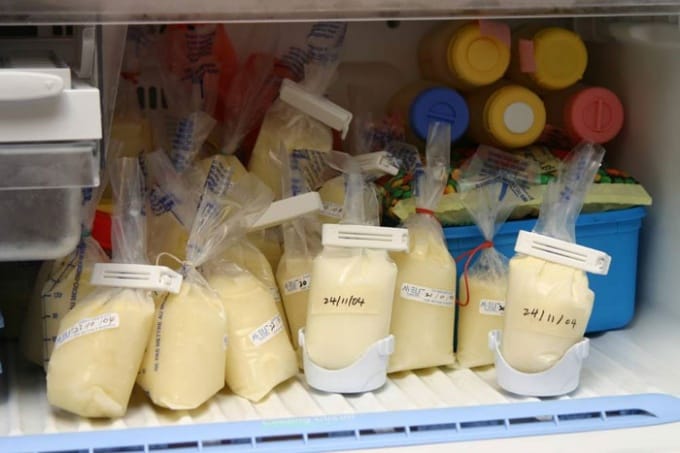
STORING EXPRESSED BREAST MILK
In rare cases, for various reasons, mothers cannot breastfeed their babies. If the reason is the baby’s health condition, the mother can express her milk and feed the baby, or store the milk for later use. Human milk can also be stored for later use if the mother produces more milk than is needed. More and more mothers are also choosing to collect and store milk in cases of a strong let-down reflex.
When storing human milk, it is important to pay attention to the hygiene of hands, breasts, pump, the container in which the milk is stored, and the storage area (refrigerator, freezer). Additional cleaning of breasts and nipples before expressing breast milk is not necessary, as breast milk is not sterile. It is also not necessary to discard the first few drops of expressed milk, as this milk is no more contaminated than
milk expressed later.
If using breast pumps, their proper and consistent cleaning is very important. It is also necessary to be well-acquainted with the procedures for storing and handling human milk. Storing human milk for later use (feeding the baby) is a better and safer choice than using formula.
It is important that all necessary pumping accessories, glass containers, plastic containers, bags, spoons, and other equipment are clean and hygienically sound to prevent bacterial contamination. For breast milk storage, it is necessary to avoid containers with the chemical bisphenol A (BPA) due to its harmful effects on the hormonal system.
After each pumping session, the expressed human milk must be immediately cooled under cold running water and stored at the appropriate temperature. According to the latest recommendations, home-expressed human milk is best stored at 0-4 °C for up to 8 days, preferably on the bottom shelf, against the back wall of the refrigerator. It is recommended to store expressed breast milk in smaller quantities, from 60 ml to 120 ml. This prevents unnecessarily discarding larger quantities of expressed breast milk.
If you want to combine milk pumped throughout the day into one storage container, you must first cool the milk to the same temperature and only then combine it.
THAWING HUMAN MILK
The thawing process must be gradual but sufficiently fast to preserve the quality of human milk as much as possible. The best option for thawing human milk at home is under cold running water. The temperature of the running water is slowly increased (not above 37 °C) until the milk is thawed and warmed to room temperature. If multiple bottles are being thawed simultaneously, human milk can be combined. If running water is not available, the mother can heat a container of water to a maximum of 37 °C and then immerse the bottles containing the milk. If the water needs to be reheated while warming the human milk, the mother must remove the bottles, reheat the water, and then place the bottles back into the container. The milk must not be thawed directly over a heater. Before checking the milk’s temperature, the bottles must be shaken. Another thawing option is to slowly thaw frozen milk in the refrigerator, but for no longer than 24 hours.
Thawed milk may change its taste.
It is not recommended to thaw human milk in a microwave oven, as heating is uneven, and the temperature in certain parts of the bottle can immediately exceed 55 °C, which destroys all important bioactive components in the milk. Furthermore, human milk thawed in a microwave oven can cause burns to the baby, as the temperature of such milk can be higher than estimated.
Thawed milk can be stored in the refrigerator for a maximum of 24 hours.
Under no circumstances should human milk be refrozen.
Feed the baby with freshly expressed milk first, or breastfeed directly. Otherwise, use the milk with the oldest expiration date first.
 Source: Promotion and Support of Breastfeeding in Healthcare Institutions, Slovenian UNICEF Foundation, Ljubljana, 2022 and 2024
Source: Evgen Benedik, uni. dipl. inž. živ. tehnol., Neža Ana Klemen, dipl. inž. živ. in preh. (UN), prof. dr. Nataša Fidler Mis, uni. dipl. inž. tehnol., Pediatric Clinic UKC Ljubljana; Storage of expressed breast milk in the home environment. Proceedings of the conference Breastfeeding – a victory for life (2014). UNICEF Slovenia National Committee for Breastfeeding Promotion and the Association of Lactation Consultants and Breastfeeding Slovenia.
