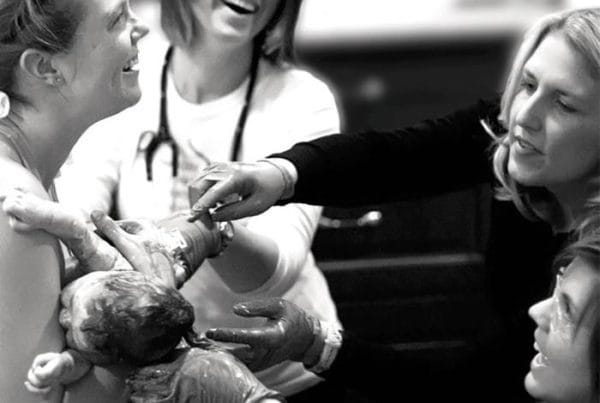
Every pregnant woman becomes frightened at the thought of childbirth, and may also feel tense. For a woman to be able to participate during labor, she must be as relaxed and calm as possible, which can be achieved through scents and massage. It is important that the midwife takes time to talk with the pregnant woman and also with her partner or birth companion, as the latter can be a great support during labor itself. It will be most pleasant for the baby if, after birth, they arrive in a space that smells of scents that were already familiar to them in the womb. The mother’s positive energy also has a beneficial effect on the baby, as they will be relaxed as well. Aromatherapy can greatly contribute to the well-being of both mother and baby. If the woman is afraid, adrenaline will rise, which means labor will progress poorly or even stop. During the birth of her child, the mother should use the oils she has already used during pregnancy, and her partner or companion should also be familiar with them if they have planned to use aromatherapy during labor together; otherwise, they should ask the midwife who has experience with this. A drop of a familiar essential oil helps her remain calm, relaxed, focused, and gives her the energy she so desperately needs during labor (Rončelj and Skoberne 2002).
Farrer-Halls (2007) describes that aromatherapy during pregnancy provides a sense of comfort and satisfaction, while also strengthening and alleviating some pregnancy-related discomforts. The sense of smell is greatly heightened during pregnancy, making this method even more recommended during this period. The pregnant woman must be informed about which oils are appropriate during this time. Safe essential oils include sandalwood, myrtle, ginger, vetiver, frankincense, mandarin, petitgrain, and bitter orange. Some oils cause bleeding, so their use during pregnancy is discouraged; exceptions are lavender, chamomile, and rose, whose oils can be used highly diluted during the first four months of pregnancy. All safe essential oils can be used during pregnancy, but it is recommended that the pregnant woman use only half of their usual dosage, 1–1.5% blends for massage, while for baths, a dosage of 3–4 drops is recommended. During pregnancy, women most often experience lower back pain and find it difficult to lie on their backs, so they are massaged while sitting on a chair, leaning the front of their body against the back of the chair, which is covered with a towel. Swollen ankles and tired legs also present a problem during pregnancy. Gentle massage with circular movements in the ankle area is recommended. For morning sickness, the most effective remedy is tea made from ginger, chamomile, and peppermint. Inhaling ginger can also help, but the pregnant woman must not use peppermint for inhalation (Farrer-Halls, 2007).
Gabriel (2011) describes a friend who prepared intensively for childbirth and put a lot of effort into aromatherapy as well. Her response was that even though she used peppermint, the labor was demanding. The author agrees with her, believing that one of the most powerful lessons we can learn from past experiences is to create what we want. She finds it important that we know how to control ourselves.
A study was conducted involving women who were generally healthy, had uncomplicated labor, but had an episiotomy. Some postpartum women were treated with lavender oil, while others were not. The results showed that those who used the essential oil did not experience pain. A larger proportion of postpartum women who did not feel pain were in the group that used the oil, from which we can conclude that the use of lavender oil truly has an analgesic effect (Buckle et al., 2009).
Essential oils can be used during pregnancy, labor, and postpartum. They can alleviate numerous discomforts, including nausea and pain. Smell is one of the first senses to develop in the womb. Research has shown that a baby can identify their mother by the scent they received in the womb. Inhalations of peppermint, spearmint, and lavender alleviate nausea. Lavender and rose help relieve anxiety during labor. German chamomile and Immortelle have strong anti-inflammatory and healing effects. If we add lavender to them, we get an effective oil for perineal healing. Rose and lavender also effectively influence postpartum depression and anxiety. Aromatherapy is very useful in reducing stress, which includes childbirth. The article mentions that rose oil is effective for the first stage of labor, as it calms and soothes. Jasmine, peppermint, frankincense, and back massage are more recommended for the transition phase. Midwives must be sufficiently educated to know when essential oils are contraindicated (Buckle et al., 2014).
Rončelj and Skoberne (2002) believe that for the first stage of labor, as much rest and relaxation as possible is recommended, which can certainly be achieved through massage of the back, shoulders, hips, or whatever suits the woman individually. Buckle and colleagues (2004) state something similar. Namely, rose essential oil calms and has an antidepressant effect, as does jasmine essential oil. Lavender oil reduces anxiety, improves mood, calms, and relaxes. For refreshment, eucalyptus essential oil is recommended, which also has a calming effect, while chamomile is known to prevent agitation. It is recommended to add marjoram and rosemary essential oils to the bath, and they can also be used for inhalation, massage, or room scenting. The laboring woman can massage her neck and shoulders herself if it calms her, lying down or sitting, using a drop of massage oil. If the pregnant woman massages her hips, she relaxes while also preventing cramps in the buttocks and hip area. She massages her hips by lying on her side, slightly bending her upper leg and massaging it in circles from the anterior iliac spine across the buttocks, then turning over, bending her leg toward her chest again, and repeating the process (Rončelj and Skoberne, 2002).
For vomiting and nausea, Rončelj and Skoberne (2002) state that it is best to use the essential oils of peppermint, chamomile, basil, lavender, and anise, as these also calm the stomach. A drop of oil can also be applied to the laboring woman’s forehead, which causes a burning sensation but also reduces nausea. If a woman is in a certain position for a long time during labor, muscle cramps can occur as blood circulation is interrupted. This can be reduced by massaging the legs and hips. Massage should always be performed in the direction toward the heart, as this stimulates blood circulation.
OILS IN THE DELIVERY ROOM
Rose essential oil is known to help soften pelvic ligaments, relax the uterus, is a natural antiseptic, helps with heart function, and has a mild anesthetic effect. Tiran (2006) explains that rose, along with jasmine and neroli, is one of the most expensive oils. Tiran (2006) states that it has a positive effect against depression and insomnia and increases contractions. The oil can be used alone or diluted (Rončelj and Skoberne 2002). England and Horowitz (1998) agree that jasmine is excellent for helping with contractions and can be used with compresses placed on the woman’s abdomen, while lavender is similarly relaxing and can be used to refresh the scent in the room.
Tiran (2006) describes that neroli essential oil affects the nervous system and enables easier breathing. It has a calming effect and is used by placing 1–2 drops on a cloth or in a diffuser. Lavender oil acts as a mild anesthetic, has a calming, anti-inflammatory, antiviral effect, accelerates wound healing, helps with headaches, fainting, and stimulates blood circulation. Tiran (2006) adds that it helps relieve labor pain and assists with low uterine activity (contractions). Clary sage essential oil relieves tension, can cause confusion and drowsiness in people, reduces pain, stimulates the function of the reproductive organs, muscles, and breathing. During contractions, it can be used to massage the abdomen, as it stimulates contractions and consequently speeds up labor. It also relieves tension (Rončelj and Skoberne, 2002). Rončelj and Skoberne (2002) describe that geranium oil facilitates breathing by stimulating blood circulation, strengthens the uterus, draws together stretched tissues, so it is somewhat recommended only after birth, as it has a positive effect on the reproductive organs. It regulates emotions while also having an antidepressant effect. Jasmine essential oil is highly recommended during labor, as it makes contractions stronger and thus shortens the labor process. It also has a calming effect, increases energy, improves mood, reduces fear and tension, increases confidence, and helps with breathing. During massage, it can be used together with lavender essential oil. One of its important effects is that it helps with placental delivery. Tiran (2006) also adds that it helps with postpartum depression. Citrus madurensis or mandarin essential oil acts as an aid for relaxation and against constipation. Rončelj and Skoberne (2002) add that it restores energy. Chamomile essential oil soothes internal tension while also reducing pain.
Aromatherapy in the First Stage of Labor
The muscles of the uterine body contract during this stage of labor, while the cervix dilates. A relaxing bath containing 2–3 drops of lavender essential oil is recommended. If the laboring woman prefers, we massage her back, apply compresses to her back or abdomen, as they speed up labor and ease pain. Essential oils for compresses can be prepared as follows: add three drops of clary sage, jasmine, or lavender oil to 300 ml of warm water. Mix well and soak a cloth in the mixture, wring it out, and apply it to the area where pain is present until the compress becomes cold. We must not forget to change positions during labor. We can also add three drops of a favorite essential oil to a pitcher of hot water to freshen the room. We can use lavender, lemon, bergamot, or geranium. All these oils can be combined by mixing two, or at most three, together. If we massage the abdomen, we can relieve pain in this area. All movements are performed only if they suit the laboring woman. We can massage the abdomen from the side, for example, with the woman on all fours, the partner positioned behind her massaging with circular movements. If the laboring woman is lying on her back, we can massage the lower back area with circular movements. We make sure to massage with the entire palm surface and perform circular movements (Rončelj and Skoberne 2002).
It is known that the transition phase is the most difficult. Toward the end of the first stage of labor, contractions become the strongest. The transition phase lasts varying lengths of time; here women are already very tired and tearful, may also be in a bad mood, some vomit, feel nauseous, and shiver. The laboring woman will feel a spontaneous urge to push, but must not push if she is not fully dilated. In this phase, for those women who prefer it, we shake their legs and can also massage them. It is most recommended to place a wet cloth on the woman’s face, soaked in a bowl of cold water to which we have added two drops of rose, neroli, or lavender essential oil (Rončelj and Skoberne, 2002).
Aromatherapy in the Second Stage of Labor
This stage typically lasts from full cervical dilation to the birth of the baby. Here the woman can participate by pushing according to her feelings. If the woman feels she cannot breathe in a controlled manner, we can help her with 1–2 drops of neroli essential oil applied to a cloth beside her head. To help the woman calm her breathing and improve her mood, we can add 1–2 drops of mandarin, neroli, ylang-ylang, or geranium essential oil (Rončelj and Skoberne, 2002).
If an episiotomy or tear occurs during labor, a bath that promotes wound healing is recommended. Adding cypress, lavender, or geranium oil to the bath helps heal tears, prevents infection, and stops bleeding. Three drops of cypress and three drops of lavender can be used (Merlene, 1994).
Aromatherapy in the Third Stage of Labor
The third stage of labor lasts from the birth of the baby to the delivery of the placenta. The woman can be given compresses on the lower abdomen. The compresses are soaked in hot water containing 2–3 drops of jasmine essential oil. The compresses need to be changed each time they cool down or until the placenta is delivered. Rest is recommended after birth, although it is quite difficult to achieve in a postpartum woman due to excitement. A few drops of lavender or neroli essential oil can be placed on a handkerchief beside her head (Rončelj and Skoberne, 2002).
Tiran (2006) describes that for a woman whose second stage of labor proceeded without complications but the placenta will not separate in the third stage, jasmine essential oil can be used, massaged on the uterine fundus through the abdomen, along with lavender.
Cesarean Section and Aromatherapy
Tiran (2006) states that it is recommended to perform aromatherapy several weeks before a cesarean section to make the surgery as stress-free as possible for the mother. Essential oils such as lavender can also be used in a water bath, as this can reduce infection in the abdominal area. After surgery, oils that reduce pain can be used, allowing the woman to recover more easily and quickly.
Postpartum Depression
It is known that alternative methods can also help with postpartum depression. A clinical study has shown that massage has a beneficial effect on treating postpartum depression. There is no evidence that aromatherapy alone helps with postpartum depression, but there is evidence that the combination of essential oils and massage has a beneficial effect on postpartum depression (Glosser, 2010).
Source: Thesis by Erika Cuznar – Aromatherapy in Different Life Stages of Women and the Perinatal Period (2015) under the mentorship of: Senior Lecturer Teja Škodič Zakšek, BSc Radiography, BSc Midwifery, MSc UK
Photo: Canva