Before you is the story of a strong, brave, determined, and persistent woman, and above all, a mother driven by love for her son. It’s a story of success, desire, and what we are capable of when we make decisions in life. I am grateful that she was willing to share her story with you, who might find yourselves in a similar predicament, and that this story will instill courage and strength in you. It’s not easy, it’s true. But it’s worth it. And if you do everything you can in a given situation, you have nothing to reproach yourself for. All I can say is congratulations and bravo.
The story…
“When I was expecting a child, more than anything in the world, I wanted my birth experience to be perfect. I attended workshops on breastfeeding, focused on the best positions to choose, extensively discussed how to write a meaningful birth plan, and diligently went for acupuncture. I spent a lot of time thinking about the kind of birth I wanted, how much it would hurt, how to avoid tears, and how to preserve my perineum intact. I waited for Braxton Hicks contractions, then false labor, and finally real natural contractions. I visualized myself opening like a rosebud. I did spiritual preparation for birth, convincing myself that I could do anything because I am a woman. Above all, I did not want a C-section and the birth I ultimately experienced. Why? Because it was extremely painful.
At 41 weeks of pregnancy, my labor was induced. I was hooked up to artificial contractions all day, I dilated extremely slowly, the baby wasn’t descending, I wasn’t allowed to eat or drink, and in the end, I had a C-section to save both the baby and me. Therefore, I didn’t experience my golden hour with my son. I woke up in the hallway outside the operating room, feeling like I’d been run over by at least ten trucks that had specifically focused on driving over my abdomen. And yet. I was woken from the anesthesia by the cry of my newborn baby. And when they brought him close to my face, the baby stopped crying, I kissed him and said: “So here you are…”, and then sank back into a dazed sleep.
When I woke up again in intensive care, I immediately asked the nurse to bring me the baby because I wanted to breastfeed him. They brought him to me, and he was the most perfect creature I had ever seen in my life. My son. My beloved son. I latched him on, but my nipple seemed far too small for his hungry mouth. Even during pregnancy, I had worried about this as I watched my growing breasts with small nipples. So, I had already brought nipple shields. My breasts became fuller each day, but my baby still didn’t “latch.” When he came to me, he fell asleep. I couldn’t bear to see him hungry, so he received formula. My husband brought me different nipple shields to the hospital that would fit my nipple better, but that wasn’t successful either. After the C-section, it was difficult for me to sit and latch the baby, but I did. Yet, nothing came out of my breasts. No matter how much my baby sucked, he remained hungry, and my breasts became harder. So something was happening… I was extremely afraid of mastitis, so my sister brought her manual pump to the hospital. While the baby slept peacefully next to me in his crib, I diligently sat on the bed and pumped. Finally, colostrum started to flow from my nipples. There was so little of it that the expressed milk foamed up as the vacuum was created. And yet… I cannot even express in words how proud I was of my body, and the burdens it could bear. I was the happiest mother in the world when the expressed milk covered the bottom of the pump. How much was there? Perhaps a milliliter, maybe even less. The nurses in the maternity ward chuckled a little when I gave them those meager amounts of pumped milk to store in the refrigerator. But I didn’t let them convince me that the baby would grow no matter what – with or without my milk.

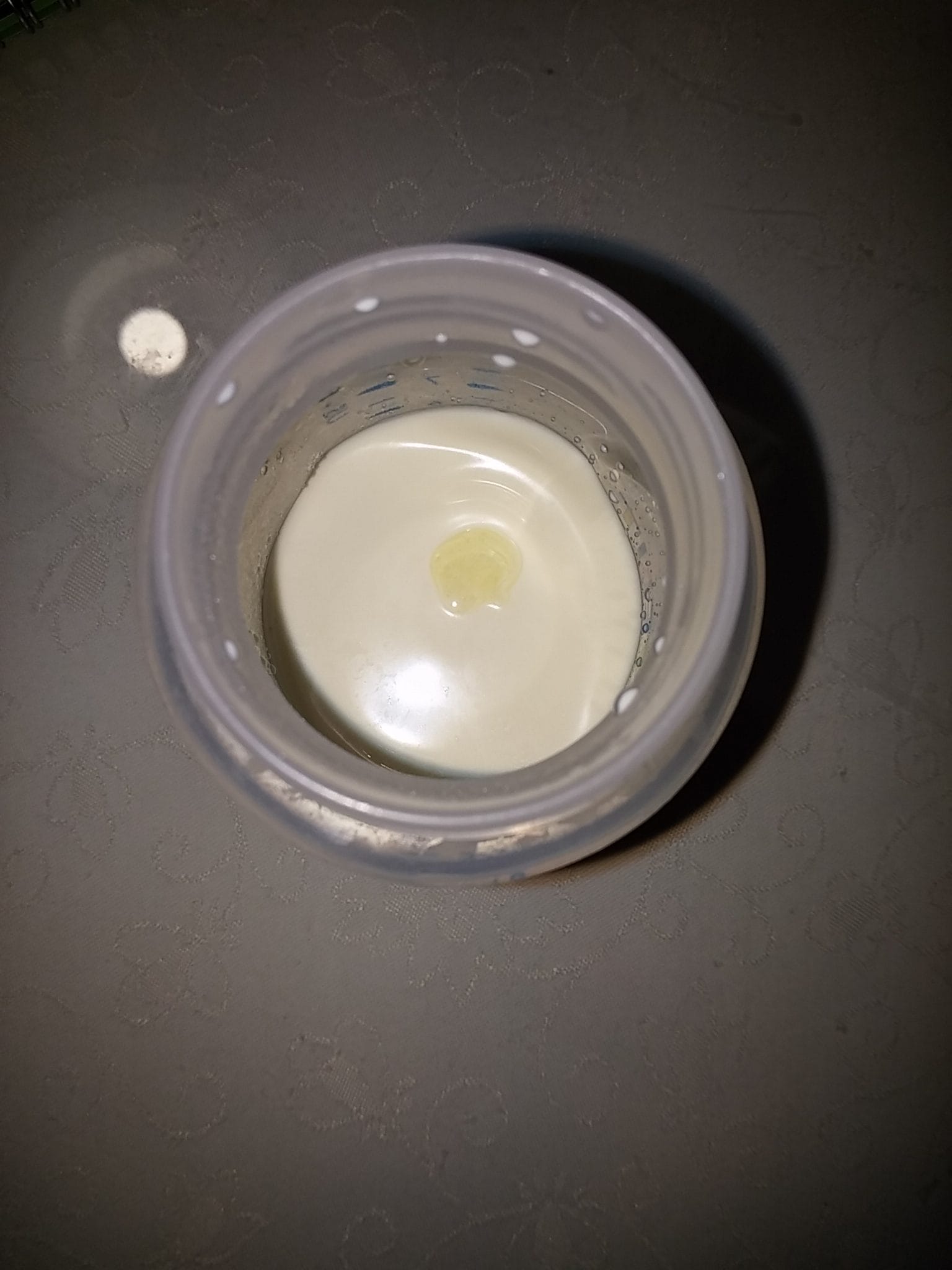
Figure 1: Fat in breast milk.
And the pumping story continued. My baby still didn’t latch, and when he was one week old, I called a lactation consultant to my home, because I wanted to breastfeed more than anything in the world. And what were her words? That the baby already showed great nipple confusion and that I should leave him for 14 days to sleep and rest, because he was so tired from the birth. And during that time, I was still pumping. How much time did this pumping take me? Quite a lot. Two hours per breast in the morning, at noon, and in the evening. So, that amounted to a full twelve hours of pumping per day. I decided not to pump at night. I decided that my body also deserved rest. I also saw that this couldn’t go on, so I rented an electric pump. This one was much more efficient in terms of vacuum, and it also went a bit faster. I spent an hour and a half per breast per pumping session. Thank goodness my husband was home, because he could take care of the baby, and the little one also liked that I was sitting and pumping while he slept on my leg. When my husband went back to work (to my surprise, the world didn’t stop when we had a child), this also took too much of my time. So I bought another electric pump, which cut the time in half. And so, I pumped simultaneously from both breasts.

Figure 2: Three weeks postpartum
My baby still didn’t latch; in fact, it was getting worse. Whenever I tried to latch him, he screamed hysterically and resisted, but he was always happy to drink all the pumped milk. There was a way to “force” him to latch, through co-sleeping. But I didn’t have the mental or physical strength for something like that. The worst thing in the world is to see a hungry and weak baby who is completely dependent on you. Nevertheless, I was not prepared to accept that my child would not receive my milk.

Figure 3: Chilled milk – composition.
The desire for the baby to receive my milk became an even stronger decision when the baby was five weeks old. At that time, he suffered from such severe colic that we were hospitalized. There, they took his blood, and his liver tests were so bad that they suspected liver failure. There is nothing worse in the world than for a mother holding her newborn baby to be told: “Madam, we don’t know what to do!” They inserted an intestinal tube into the baby to release all the gases, and I also made a decision – the milk must not stop! And so it didn’t. I still tirelessly pumped, pumped, pumped. He received at least one meal a day with my milk. And the story continued. Soon I pumped enough for him to get three daily meals with my milk. With persistence, I reached the point where he was fully breastfed, one pump gave up the ghost and we got a new one, then there was so much milk that I could even freeze some for “hard times.” My special breastfeeding journey lasted a full eight months. In the end, I had 23 containers of my milk, 120 ml each, in the freezer. And yet, I was already looking forward to stopping this pumping, as it was exhausting me both physically and mentally. Many times I felt like a dairy cow. And yet… it was worth every minute. Would I repeat the story? I don’t know. The fact is that pumping would not have been possible without all the factors that contributed to it. Also, the fact that my child patiently waited an hour and a half every morning
Figure 4: One month postpartum, first filled container.
What I want to say is that every mother is unique, just as her child is unique. Everyone has their own story that is important to them, and things unfold in a way that they can handle, if only they have the desire. When you know it’s about your child’s health, despair no longer has a place in your life. All you can do is try your best. And when you see what amazing things your body is capable of, you are proud of it, just as I am of mine. Life is a miracle, just as the body, nature, a child, and motherhood are miracles. The fact is that in life, we are only given what we can bear. And this is my breastfeeding story. Beautiful, challenging, amazing, and mine. Just like my child, who has become a healthy and vibrant toddler, full of joy and happiness. And every time I hear his voice call me “mama,” I realize it was worth it.”

Figure 5: 4.5 months postpartum, first filled both containers.
Read more:
- Breastfeeding – 3 months of effort
- Aromatherapy, Breasts, and Breastfeeding
- Dysphoric Milk Ejection Reflex
- Breastfeeding in the delivery room
- 9 instinctive phases of the newborn
- Lactation Cookies – Recipe
- Breastfeeding after 1 year of age
- Storing Breast Milk
- Hormones important for breastfeeding
- Breast Changes During Breastfeeding
- Use of Medications During Childbirth and Their Impact on Women and Breastfeeding
- Milk Let-down or Milk Ejection Reflex