The most common spontaneous injuries sustained by women during childbirth are perineal tears. A perineal tear (Latin: ruptura perinei) is an injury to the perineum that occurs spontaneously as the baby is delivered through the vagina toward the outlet. These injuries result from the forces exerted by the baby’s head at the end of the second stage of labor on the internal part of the perineum. The perineum is typically injured at the point where the tissue is thinnest, meaning that the vast majority of injuries are directed toward the anal sphincter (Čeh, 2011). Causes of perineal tears include (Lee and Mc Kay-Moffat, 2006): an inelastic and rigid perineum; a high perineum; a scarred perineum due to a previous episiotomy; more severe soft birth canal injuries from a previous delivery; frequent vaginal infections (colpitis), which make the vaginal mucosa more sensitive; a large baby (a baby weighing 4000 g or more); shoulder dystocia; rapid labor (Latin: partus precipitatus) and overly rapid delivery of the baby’s head over the perineum; improper management of the second stage of labor (pushing the baby down too quickly, applying fundal pressure in an attempt to expedite delivery, etc.); excessive perineal massage during labor; instrumental vaginal delivery (such tears are often combined with episiotomy); delivery in an upright position (squatting, sitting, on all fours, etc.), which in most cases results in minor injuries to the vaginal mucosa, first- and second-degree perineal injuries, and predominantly injuries to the labia minora and the area around the clitoris; vaginal delivery of twins and delivery of a baby in breech presentation; malpresentations (abnormal positions of the baby’s head during delivery, such as: vertex, face presentation, occipito-posterior position), as in these positions the baby’s head is delivered at its largest circumference. Lewis, Williams, and Rogers (2008, cited in Čeh, 2011) describe that the main risk factors for more severe perineal injury, in addition to those already listed, are primiparity and induced labor. Gaskin (2007) notes that there are fewer perineal tears in home births.
Degrees of Perineal Tears
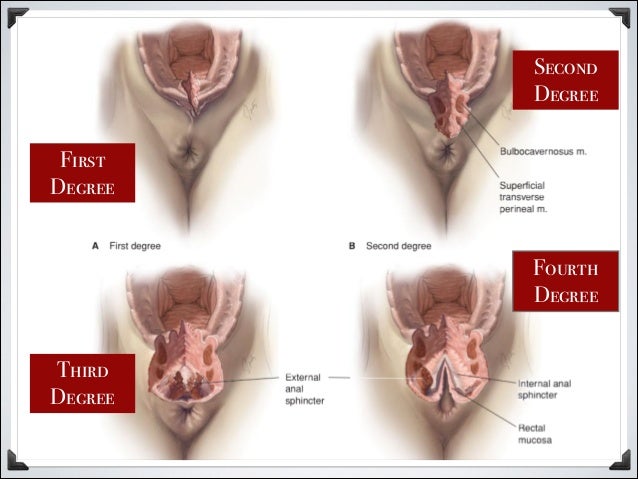
There is no uniform classification of perineal tears. Depending on different classification systems and the extent of injury, perineal tears are divided into three, four, or five different degrees. Marc and Toglia (2009) divide perineal injuries into four basic degrees with individual sub-degrees:
- first-degree perineal injury: involves injury to the frenulum labiorum pudendi, the skin of the perineum, and the vaginal mucosa, without fascia or muscle involvement;
- second-degree perineal injury: involves injury to the perineal skin and pelvic floor muscles (which is why some authors also include episiotomy in this category);
- third-degree perineal injury: as in second-degree injury with associated injury to the anal sphincter. Depending on the extent of anal sphincter injury, third-degree injury is divided into three sub-degrees:
- injury 3a – less than 50% of the external anal sphincter is damaged;
- injury 3b – more than 50% of the external anal sphincter is damaged;
- injury 3c – the internal anal sphincter is also damaged;
- fourth-degree perineal injury: third-degree injury with complete tear of the anal epithelium.
A very detailed classification of perineal injuries is the classification by Vicky Chapman (2008), which divides perineal injuries into anterior and posterior. Posterior injuries are classified in the same way as Marc and Toglia (2009) classified them. Among anterior injuries to the perineal area, Chapman (2008) includes injuries to the labia minora and majora, injuries to the anterior part of the vagina, injuries in the area of the urethra and clitoris. In practice, anterior injuries to the perineal area can often be seen with an intact perineum.
Comparison of Episiotomy with Perineal Tear
Proponents of episiotomy claim that episiotomy prevents third- and fourth-degree perineal tears and the associated subsequent urinary and fecal incontinence (Pajntar and Antolič Novak, 2004). Robinson (2009) believes that episiotomy prevents tears during instrumental deliveries (e.g., vacuum extraction); allows easier suturing and healing due to straight wound edges; maintains pelvic floor muscle support; prevents injuries to the newborn (especially cranial injuries in premature newborns and injuries in macrosomic newborns during shoulder dystocia) and thus prevents cerebral palsy; prevents shoulder dystocia; shortens the second stage of labor and thus protects the baby from distress and the woman from additional strain.
Opponents have already refuted most of these arguments (Drglin, 2003; Wagner 2008). Drglin (2003, 187) in the book Rojstna hiša – kulturna anatomija poroda introduces us to many studies that reject the routine and excessive use of episiotomy. For example, she writes that episiotomy is no less painful than a tear. Pain always occurs after episiotomy, whether severe or moderate, and 85% of women require analgesic medication after delivery because of it. Childbirth causes a painful perineum, and it has not yet been determined whether episiotomy is more or less painful than spontaneous tears. After episiotomy, anatomical results may be unsatisfactory, for example because the incision is sutured too tightly, asymmetrically, not tightly enough, or inaccurately (as described in some studies), which means that episiotomy is by no means easier to suture than a tear. The scientific literature does not provide a clear answer to the question of whether long-term anatomical results are better with or without episiotomy. Painful sexual intercourse after episiotomy is rarely mentioned in obstetric literature, but studies show that it is very common. Episiotomies can become infected, with a higher risk of infection. Episiotomies do not prevent birth injuries or brain damage to the baby. Wagner (1994, cited in Drglin, 2003) emphasizes that there is no evidence that when the second stage of labor is progressing well and the condition of mother and baby is satisfactory, an upper time limit should be used to justify waiting with various techniques for shortening labor (including episiotomy). The use of such limits should be abandoned. Episiotomy increases blood loss, can lead to vaginal prolapse, and can result in fistulas, abscesses, and hematomas. According to Wagner (ibid.), episiotomy does not protect against uterine prolapse, as some have assumed. The reason for the lower number of these problems is more likely attributed to the smaller number of children that the average woman gives birth to in modern times (Drglin, 2003).
Episiotomy can also leave psychological consequences (Mivšek, 2012a). Women’s self-image can be impaired, which is why some authors, including Kitzinger (2006, cited in Mivšek, 2012a) and Wagner (2009), suggest that the mass use of episiotomy is in a way female genital mutilation, with which Wagner thoroughly shook the Slovenian public and representatives of the medical profession in 2009. A perineal incision means long-term discomfort for many women: pain before it heals, especially on the second or third day after the incision, swelling may occur, the woman has difficulty walking and sitting, the perineum hurts when she coughs, sneezes, or has a bowel movement (Drglin, 2003). Healing of an episiotomy wound is more painful and prolonged than healing of a tear. A perineal incision causes pain in the postpartum period, which sometimes lasts for weeks or months, and dyspareunia (Holmes and Baker, 2006). Due to pain, bonding with the baby, breastfeeding, and the woman’s sexual life are impaired (Kitzinger, 2006, cited in Mivšek, 2012a). First- and second-degree tears (up to 2 cm) heal faster and less painfully than episiotomy. Some claim that more severe tears that also affect the anal sphincter can leave serious consequences for the woman—mainly fecal incontinence, and therefore the reason to avoid these tears is the most common indication for episiotomy, but one of the important causes of fecal incontinence is also episiotomy itself (WHO, 2003, cited in Mivšek, 2012a), as it has been proven that episiotomy is associated with a higher percentage of third- and fourth-degree tears (WHO, 2003). Drglin (2003) also informs us that medical research data support the thesis that the orientation of the midwife or obstetrician, technique, skill, and experience are the main determinants that decide whether the perineum will remain intact during childbirth. If the wound is not carefully and professionally sutured, an unpleasant scar remains, causing problems in later sexual life. Severe pain, painful sexual intercourse, infections, or deformed vaginas can greatly affect women’s lives.
Regarding urinary incontinence, Walsh (2007) found that perineal injuries are not the cause of urinary incontinence; other factors during childbirth are more important: prolonged increased pushing in the second stage of labor, the woman’s age at delivery over 30 years, babies weighing over 3700 g and with a head diameter of more than 35 cm, excessive bladder distension during and after delivery. Very important for the midwifery profession is the data cited by Mivšek (2012a) and interpreted in an extensive study covering 56,471 births, conducted by Pel and Heres (1995), that when midwives do not perform episiotomies, third-degree rupture occurs in 0.4% of cases. When they performed mediolateral episiotomy, the percentage was the same, but when they used median episiotomy, the percentage of third-degree ruptures was 1.2%. This only further proves that the frequent and routine use of episiotomy is truly not justified.
Several authors describe a connection between performed episiotomy and more severe perineal injury. Moimi, Yari, and Eslami (2009, cited in Čeh, 2011) investigated the connection between third- and fourth-degree perineal tears in two groups of women. One group of women gave birth without episiotomy and the other with episiotomy performed. The study included 283 women at term, with singleton pregnancies and no complications during pregnancy. It was found that the group of women with episiotomy performed had a significantly higher percentage of perineal injuries (13.14%) compared to those in whom episiotomy was not performed (2.05%). Similar conclusions were reached by Aytan et al. (2005, cited in Čeh, 2011), who say that perineal injuries with episiotomy performed are 15.4% more common.
A study was conducted in Slovenia (Čeh and Pogorelc, 2009, cited in Čeh, 2011), which also found a statistically significant connection between performed episiotomy and more severe perineal injuries. Primiparous women with third-degree perineal rupture had episiotomy performed in 55.4% of cases. Similar results were also found for fourth-degree perineal tears. Unlike primiparous women, the results for multiparous women differed diametrically. Multiparous women who had a more severe perineal tear did not have episiotomy performed in 73% of cases, which indicates that midwives decide to perform episiotomy less often in multiparous women, while being aware that more severe perineal injuries are significantly more common in primiparous women. The data were obtained from the National Perinatal Information System of Slovenia (NPIS) for the period from 2000 to 2005. Negative effects on the frequency of perineal injury are also evident in induced and stimulated labors. The study also showed that the percentage of episiotomies is significantly higher in women whose labor was induced (33.9%) and shorter than 4 hours. In the observed period, 27.1% of deliveries in primiparous women were induced, of which more than half had episiotomy performed.
Prevention of Perineal Tears and Measures to Reduce the Use of Episiotomy
Opinions and recommendations for preventing soft birth canal injuries vary in professional literature. A midwife can suggest certain measures to a woman already during pregnancy that improve the quality of perineal tissue and demonstrably reduce the need for episiotomy during childbirth. Perineal massage is recommended from the 28th week of pregnancy onward or at the latest after the 35th week (Tritten, 2005; Mivšek, 2012a). Special ointments for perineal massage are available in drugstores, but women can also be advised to massage the perineum with oils containing high amounts of vitamin E (e.g., wheat germ oil, shea butter), as it affects better tissue elasticity. Gumze (2010) also recommends St. John’s wort or rose oil for perineal massage, which has been valued in the field of obstetrics since ancient times. Its general property is that it acts antiseptically and relieves cramps. McKay-Moffat and Lee (2006) and Tritten (2005) state that to prevent soft birth canal tears, care must be taken during pregnancy, namely with a balanced diet for the pregnant woman (food rich in proteins, vitamins—especially high intake of vitamins E, B-12, D, and C, and minerals), early detection and timely treatment of vaginal infections, proper hygiene of the anogenital area, performing exercises to strengthen pelvic floor muscles (Kegel exercises), and using complementary methods—perineal massage with essential oils is recommended; according to Gumze (2010), essential oil of Moroccan or Turkish rose can be used. Mivšek (2012a) describes that it is good for the midwife to discuss with the woman during pregnancy certain interventions during childbirth that increase the need for episiotomy, such as epidural analgesia, lithotomy position in the second stage of labor, excessively spread legs during the expulsion of the baby, and instrumental deliveries. It has also been proven that the percentage of episiotomies and perineal injuries is reduced by the constant presence and support of a midwife. She should accompany the woman during pregnancy, childbirth, and the postpartum period. A psychophysical sense of security relaxes the woman and thus relaxes the pelvic floor muscles (Hofmeyr, 2005, cited in Mivšek, 2012a).
The elasticity of the perineum during childbirth is improved by warmth, so the literature recommends the use of warm compresses in the perineal area or the use of warm water (bathing, showering) in the first stage of labor (Dahlen, 2005, cited in Mivšek, 2012a; Tritten, 2005). According to oral statements by Slovenian midwife Mersa Husić, who practices midwifery in Germany, midwives there recommend an herbal bath made from hay flowers to improve perineal elasticity, in which a pregnant woman can bathe from the completed 38th week of pregnancy. This is also confirmed by Gumze (2010), who adds that hay flowers are a plant that was regularly used by traditional (lay) midwives in the past. A steam or sitz bath made from hay flowers has a relaxing effect, accelerates and regulates contractions, making them more regular. Frye (1995) and Tritten (2005) state that during labor, warm compresses made from ginger or gauze are useful, which are placed on the periurethral and perineal area. Likewise, just before the birth of the baby’s head, the midwife can apply appropriate oil or water-based lubricant to the perineum.
In old midwifery textbooks, we can even find that for a very high perineum, delivery on the side was recommended (Figure 10). In this way, the midwife could avoid episiotomy, while actively managing side-lying delivery without risking the occurrence of more severe tears. Such a birth position was also recommended for less experienced midwives who were at the beginning of their professional career (Bumm, 1914).

Figure 10: Side-lying birth position with a high perineum (Bumm, 1914)
Regarding certain measures during childbirth that are supposed to increase the need for episiotomy, there is still no consensus. Controversial are: labor augmentation, fundal pressure in the second stage of labor, and several other interventions related to medicalized labor management, which are associated with a lying position and thus with a series of interventions that ultimately lead to an increased risk of tears and/or episiotomy (Mivšek, 2012a). Recommended positions during the second stage of labor that demonstrably reduce the need for episiotomy are upright, squatting, kneeling, or hands-and-knees positions. In an upright position, the birth mechanism also proceeds differently. The baby’s posterior shoulder is delivered first. This prevents the occurrence of ruptures that would otherwise be caused by the posterior shoulder, which is delivered second (Walsh, 2007, cited in Mivšek, 2012a; Tritten, 2005). Frye (1995) also states that an appropriate position during the expulsion of the baby contributes significantly to reducing tears during childbirth. She recommends that the woman in labor have her legs spread at the knees and feet approximately 30–40 cm apart during delivery, regardless of whether the woman is squatting, sitting, lying, or kneeling. The midwife’s task is to carefully observe the perineum and accordingly choose an appropriate birth position together with the woman. Drglin (2003) describes that giving birth on the back with legs far apart in stirrups increases the possibility of episiotomy and tears because the perineum is overstretched and because the pressure on the pelvic floor is too great. According to McKay-Moffat and Lee (2006), episiotomy and perineal tears can be prevented by proper management of the second stage of labor. The woman in labor should push only as much as the contractions push (physiological pushing); fundal pressure should not be used, as it induces the Valsalva maneuver (strong tensing of abdominal and pelvic muscles). Physiological pushing allows the presenting part of the baby to slowly and gently stretch the perineum (Holmes and Baker, 2006). Petrovič (2010) states that during the Valsalva maneuver, pressure in the chest increases, which hinders the return of venous blood to the heart, and as a result, the woman in labor experiences dizziness and lightheadedness. Consequently, studies have found (Lemos, Dean, and Andrade, 2011) that bradycardia can occur in the baby, and pH values of umbilical cord blood also change, which compromises the newborn’s well-being after birth. Strong pushing increases blood pressure in the mother and can also cause small capillaries in the face and eyes to burst. Mivšek (2012a) describes that there has been much debate about whether it makes sense to protect the perineum during the birth of the baby or not. From studies that have tried to provide guidelines on this, Mivšek (2012a) summarizes that protection does not significantly affect the stretching of perineal tissues and consequently the need for episiotomy or the percentage of tears when we are talking about natural childbirth. According to WHO (2003), controlled delivery of the presenting part of the baby can reduce the possibility of tears, but at the same time, the midwife can also trigger them through unskilled handling. Čeh (2011) states that in Slovenia, the proportion of episiotomies could be significantly reduced by restrictive use of syntocinon (oxytocin). This measure would also reduce the number of induced and stimulated labors, but the second stage of labor would be somewhat prolonged. Without adopting the mentioned additional measures, reducing the number of episiotomies can lead to a significant increase in perineal tears. Chapman (2008) states that the midwife who manages or attends the birth must provide support to the woman throughout labor and give clear and precise instructions, the environment in the delivery room should be relaxed and calm, and privacy must be ensured.
There is also much discussion about whether perineal massage during childbirth really prevents tears. According to Chapman (2008), invasive perineal massage during childbirth does not reduce perineal injuries. This is also confirmed by Frye (1995), who states that rough perineal massage often causes edema and tissue fragility, so it should be performed gently. Above all, attention must be paid to the woman’s feelings in this regard. If she does not accept touch in this area, perineal protection, vaginal examinations, and massage in the second stage of labor can cause the vagina to contract, which reduces the size of the birth outlet (Mivšek, 2012a). Very interesting is the recommendation of Dr. John Stevenson from Australia, who in the handbook Tear Prevention & Treatment Handbook (2005, 18) recommends perineal massage with vernix from the baby’s head. NICE (2007) states that perineal massage during the second stage of labor is not recommended.
According to Drglin (2003), the number of episiotomies can be significantly reduced by informing women about ways to protect the perineum and by appropriate education and raising awareness among healthcare staff that it is important to protect the perineum and that episiotomy can have serious consequences.
The source of this article is the thesis “Suturing of Episiotomy Wounds and Minor Perineal Tears (2013)” by Rosemarie Franc under the mentorship of Senior Lecturer Dr. Ana Polona Mivšek, midwife.
Read also: