You can also purchase access to the online lecture “Birth positions”. Over 60 minutes of useful information.
Prenatal preparation for birth has an important impact on the birth experience. Couples need to understand the course of labour, the role of pain, birth positions, and the various interventions and procedures that are (routinely) carried out, because only then will they be able to choose a maternity hospital where their wishes are most likely to be respected. Romano (2005) emphasizes that even with induced labour, we should strive to keep it as physiological as possible. One way to do this is by enabling the woman to move during labour. In physiological labour, a mix of hormones supports progress. The woman produces endorphins that help relieve labour pain. By allowing her to move, we indirectly support coordinated hormonal activity, which contributes to greater comfort and progress in labour. Encourage the labouring woman to change positions every 30 minutes—moving from rest to activity and back again. If she finds a position that suits her and labour is progressing well in it, she should stay in it longer. She should not use positions that don’t suit her or the baby (Mothers Advocate, 2009).
Based on the baby’s position and how the woman feels, we as professionals should suggest suitable positions. She should try as many as possible to find what works best for her. Involve the partner to help her change positions, as an uncomfortable position or back pain can slow labour (Simkin, 2007). Various studies report positive effects of movement: labour is shorter, and women are less likely to want pharmacological pain relief. If the woman is already in the hospital in the early phase, her movement is often restricted due to continuous cardiotocography monitoring, despite a physiological pregnancy and a normal course of labour (Lamaze, 2009). Let’s not restrict birthing women unnecessarily. Guidelines for cardiotocography monitoring should be designed so that women are free to choose positions, while fetal monitoring still allows us to realistically assess the baby’s condition.
It is known that some women feel contractions in their lower back. The reasons are not always clear. This can happen due to the position of the baby’s head, the shape of the pelvis, or other causes. Sometimes back pain is associated with slow labour progress. With different positions, movement, and techniques, we can help labour progress and, in cases of suboptimal fetal positioning, help the baby rotate into an optimal position (Simkin, 2007; Lamaze, 2009). When admitting a woman to the labour room, we determine the fetal position with an external obstetric examination and confirm our findings with a Pinard stethoscope. It is very important that midwives are able to determine fetal position, e.g., a posterior position. We know that labour in this position takes longer. If we have not determined the position beforehand, we should consider it if the woman complains of back pain and labour is progressing very slowly. We can do a lot of harm if, in this case, we decide to augment labour, as we will affect only the descent of the head, not its rotation (El Halta, 2005). If we recognize an unfavourable fetal position, we can advise the woman—depending on the situation—how to move, which position to use, and how, or in which direction, to circle her hips to help the baby settle into an optimal position.

Simkin (2007) lists positions that are possible during labour:
Sitting: The woman should sit on a chair with the backrest in front of her belly. A pillow can be placed between the backrest and her belly, and she can lean forward and rest. This position is also suitable in the shower. In this position, the partner can massage her back and shoulders. She can also sit on the toilet or a birthing stool. If she wants to sit on a ball, someone must support her so she doesn’t fall.


All fours with knees wide apart: The woman gets on all fours, then lowers her front down onto her forearms, crossing them and resting her head on them. Her knees are wide apart, and her bottom should stay high in the air the whole time. This position can help a baby in a posterior position (facing forward) if used in early labour. If the woman has frequent, irregular contractions and the pain is felt in the lower back, and the cervix is not opening, it is worth trying this position. She should try to stay in this position for at least 30 minutes. As the baby rotates into a more optimal position, the back pain usually begins to ease.
Lying on the side: The woman can rest lying down when she is exhausted and use the break in labour.
a) The woman should lie on her side and bend her legs at the hips and knees. Place a pillow between her legs and under her head if that feels comfortable.
b) The woman should lie on her side. She should straighten the lower leg and bend the upper leg at the hip and knee. The knee of the upper leg should rest on a double pillow, and she should slightly rotate the leg forward at the hip toward the surface. She should position her arms in a way that feels comfortable.
These positions are beneficial because there is no pressure on the major blood vessels as there is when lying on the back (inferior vena cava syndrome). Most optimal is for the woman to lie on her left side.

For some, it will feel good if we also support the belly.
All fours: The woman can lean on her hands and knees. She can kneel and lean forward with the front of her body. Her upper body can rest on pillows, a ball, a chair, her partner, or anything else that is at hand and provides comfort. If the bed is adjustable, the upper part can be raised, perhaps supported with pillows, and used as a support. If it feels comfortable, she can lean on her forearms instead of her palms. To increase comfort, place a pillow under her arms if that suits her. The partner can also sit on a chair and she can lean her upper body against him.

Standing, swaying, walking, dancing: In these positions, gravity plays a strong role, and movement encourages the baby to reposition and descend. The woman can walk between contractions, and during a contraction she can stop and lean on a wall, railing, chair, partner, bed, or something else. For swaying, she can sit on a ball and sway left to right or make circles, or she can stand holding the back of a chair, hug her partner, lean on a bed, table, or something else at a comfortable height, and slowly sway her hips. She can also use a rocking chair if one is available.


Standing with one leg bent on a chair: The woman stands facing forward. Place a chair beside her with the seat facing her. She lifts the leg on the side of the chair and places her foot on the seat. Her upper body should still face forward, while her foot, knee, and hip turn toward the side with the raised leg. During a contraction, without leaning her upper body, she should slowly tilt her hips toward the chair. She should feel a stretch on the inner side of the leg. In this position, she should slowly count to 5, then return to an upright position. She should repeat the exercise for 6 consecutive contractions. Before that, she should try it on the left and on the right to see which side suits her better.
Lifted belly: While the woman is standing, she should interlace her fingers and place them under her belly toward the pubic bone. During a contraction, she should lift her belly and bend her knees. This position often relieves back pain and improves the baby’s position in the pelvis. She can also use a rebozo.
Positions in the pushing stage:
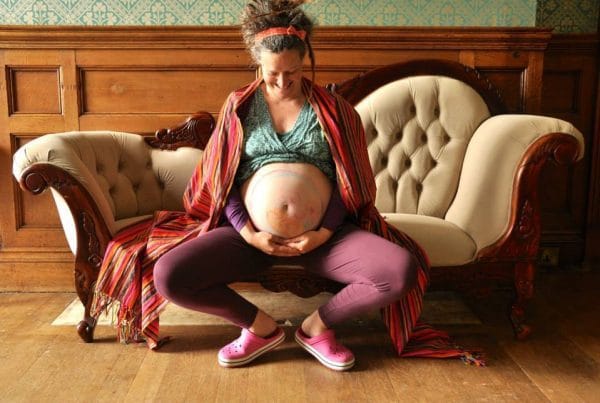
In this stage too, the woman should be given the opportunity to listen to her body and find the position that suits her best. Positions where gravity helps are very beneficial. With squatting birth, an additional advantage is that the diameter of the pelvic outlet is the largest, giving the baby more room to manoeuvre through the pelvis. Because squatting is tiring for some women, we can make it easier by offering a birthing stool or by adjusting the birth bed (if possible) into a position where the woman squats and holds onto a bar fixed across the bed on both sides. She can also squat on the floor while her partner stands and holds her hands. The partner can be replaced by a rebozo or another scarf attached to wall bars, or we can improvise in another way (tie a knot and secure it at the top of a door). The woman can also sit on the toilet or kneel. If the woman is too exhausted, she should lie on her side so the pelvis can adapt to the baby, and she should draw her knees toward herself and press. In this position, pressure on the perineum is reduced and there are fewer birth canal injuries than in a semi-sitting position or lying on the back.

It is understandable that certain health conditions in babies and mothers prevent unrestricted movement and require continuous cardiotocography monitoring. However, it is important that we do not prevent this for labouring women when it is not necessary. Hospital culture influences midwives and requires them to adapt to it. We can improve current birth practice by eliminating routine birthing on the back and in a semi-sitting position in maternity hospitals. Women should give birth on their side or in a position that suits them.

Source: Nastja Pavel – Six areas in the labour room for better birth practice (2016); master’s thesis under the supervision of Assoc. Prof. Darja Arko, MD, PhD, and co-supervision by Assist. Prof. Jadranka Stričević, PhD