
For expectant mothers, a perineal incision during childbirth represents one of the greatest traumas. However, it’s important to know that perineal care begins even before pregnancy.
What can we do for a flexible and elastic perineum?
– some of it is genetic predisposition, which we cannot influence
– a healthy and balanced diet for the pregnant woman (if possible, food should be organically processed, rich in proteins and vitamins – vitamins E, B12, C, and D, as well as minerals and foods rich in omega-3 and omega-6 fatty acids, especially affect tissue elasticity)
– early detection and timely treatment of vaginal inflammation (by wearing breathable cotton underwear and not overly tight clothing, which can cause inflammation + appropriate diet again)
– proper hygiene of the anogenital area (do not use alkaline soaps!)
– performing pelvic floor strengthening exercises
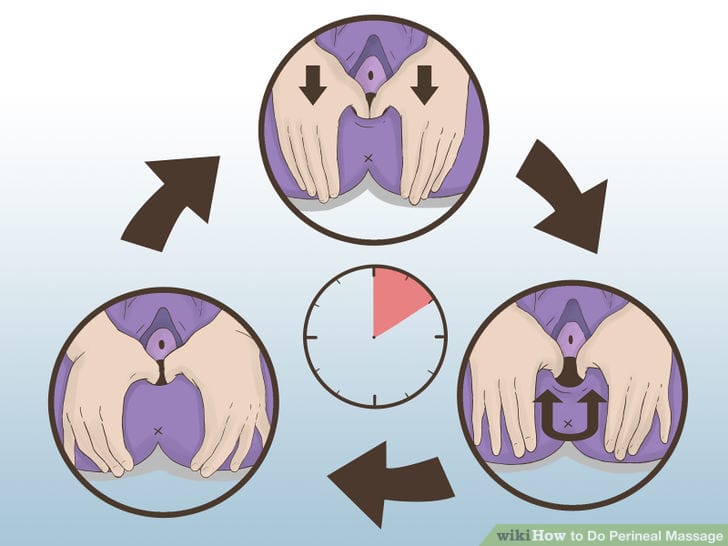
– using complementary methods (perineal massage, preferably with cold-pressed organic oils in combination with essential oils or oils rich in vitamin E. Perineal massage is recommended from the 26th week of pregnancy onwards, or at the latest after the 35th week; most authors suggest approximately 6 weeks before the estimated due date).
– steam or herbal sitz bath from hay flowers from the completed 38th week of pregnancy
– drinking raspberry leaf tea
– consulting with a midwife during pregnancy.
In the delivery room, perineal care can be provided by:
– warm compresses on the perineal area, or a warm shower or bath where water birth is possible. Compresses can be made from ginger or comfrey, but even warm water alone is effective
– the midwife lubricating the perineum with appropriate oils just before the baby’s head crowns, or with a water-based lubricant
– an appropriate position in the second stage of labor (legs spread at the knees and feet approximately 30-40 cm apart, regardless of whether the woman is squatting, sitting, lying down, kneeling; for a high perineum, old midwifery textbooks advise giving birth lying on the side; a side-lying position for pushing is an excellent choice)
– constant presence of the midwife – one-on-one model
– proper management of the second stage of labor
– if we decide on perineal massage during labor, it should be performed gently, as otherwise it can cause perineal edema and tissue fragility, and vaginal spasm if the woman does not find the massage comfortable in that area; if we opt for perineal massage during labor, some authors recommend using vernix from the fetal head instead of oil. However, NICE advises against perineal massage in the second stage of labor
– and of course, trust between the midwife and the birthing woman/couple, leading to relaxation and cooperation. (Franc, 2014)
–we encourage the mother to touch the baby’s head as it crowns
What are the degrees of perineal rupture and why do we fear that an episiotomy will progress to a III or IV degree rupture?
First degree – damaged perineal skin
Second degree – damaged perineal skin and pelvic floor muscles
Third degree – damaged perineal skin, pelvic floor muscles, anal sphincter damage
Fourth degree – in addition to all of the above, the anal epithelium is also torn
Burns (2011) provides instructions for performing massage in her manual on prenatal perineal massage.
INSTRUCTIONS FOR PERINEAL MASSAGE (Burns, 2011):
- perineal massage can be performed by the pregnant woman or her partner,
- it is best to perform the massage after bathing or showering, as warm water softens and relaxes the perineum,
- it is recommended to use unscented oil (olive, almond, vegetable, sunflower) for perineal lubrication,
- a comfortable position for massage should be chosen (sitting or semi-sitting position on the bed with bent knees, lying position while bathing in the tub with one leg raised, etc.),
- it is important that the pregnant woman is relaxed, in an environment where she feels safe and where no one interrupts her,
- the pregnant woman or partner should wash their hands, apply oil to their thumbs or index fingers of both hands, and place them in the vagina, pressing downwards towards the anus and sideways,
- this is followed by semi-circular, rhythmic U-shaped movements with gentle stretching of the vagina and surrounding tissue,
- the pregnant woman should focus on relaxing the perineum during the massage,
- the massage should last approximately five minutes or as long as the pregnant woman finds it comfortable,
- over time, as the perineum becomes more elastic, the pregnant woman or partner can increase pressure towards the rectum during the massage,
- the massage should be performed daily or every other day,
- perineal massage should not be performed by women with genital herpes or vaginal inflammation. Most women who massage their perineum during pregnancy report that the massage is acceptable to them and believe it helps them better prepare for birth (Labrecque, 2001). Pregnant women report that in the first weeks, the massage causes discomfort and a burning sensation, is unpleasant, and can even be painful. Nevertheless, most say that the burning sensation and pain disappear after one or two weeks of performing the massage. Most (79%) report that they would use massage in subsequent pregnancies, and 87% of women would recommend it to other pregnant women (Beckmann and Garrett, 2009).Given that perineal massage with fingers from 35 weeks onwards reduces the frequency of birth injuries (especially episiotomies) and perineal pain three months postpartum, and is well-accepted by women, all pregnant women should be informed about the benefits of perineal massage and the technique of its performance (Beckmann and Garrett, 2009).(Teppey, 2012).
Factors associated with perineal injuries
Literature lists the following factors that contribute to perineal injuries during childbirth:
- primiparity,
- birth weight of the child over 4 kg,
- second stage of labor longer than one hour,
- epidural analgesia,
- occipitoposterior presentation,
- induction of labor (RCOG, 2007),
- directed pushing (Valsalva) during fetal expulsion (Sampselle and Hines, 1999),
- episiotomy (Renfrew et al., 1998),
- sutured birth injury from a previous birth (Alberts et al., 2006),
- giving birth in the lithotomy position (Soong and Barnes, 2005),
- giving birth squatting (Shorten et al., 2002),
- birth managed by an obstetrician (Meyvis et al., 2012, Shorten et al., 2002),
- birth completed with an operative vaginal delivery (forceps delivery and vacuum extraction) (Labrecque et al., 1997),
- Asian race of the birthing woman (Dahlen and Homer, 2008).
The authors mentioned above reached these conclusions in their research, in which they, among other things, studied factors influencing perineal injuries.
Consequences of perineal injuries
Many women suffer perineal injuries during childbirth, which cause them pain and discomfort in the postpartum period. The injury leaves short- and long-term consequences on their health and well-being (Steen, 2010).
Short-term consequences include blood loss and infections (Renfrew et al., 1998), pain and discomfort during sitting, urination, and defecation, limited mobility, reduced ability to care for the baby, poorer lactation, and insomnia (Steen, 2010). Long-term consequences include poorer pelvic floor muscle tone (Renfrew et al., 1998), depression, exhaustion, stress incontinence, dyspareunia, and altered relationship between partners (Steen, 2010). In the first three months postpartum, approximately 23% of women experience dyspareunia, 19% urinary incontinence, and 3-10% fecal incontinence (Steen, 2010).
Thanks to Ana Teppey, author of the diploma thesis “Perineal Care During Pregnancy and Childbirth (2012); supervised by mag. Teja Škodič Zakšek, B.Sc. Rad., B.Sc. Midw., MSc (UK)”
Read more:
