Interview: Nastja Pavel aka “Moja babica”

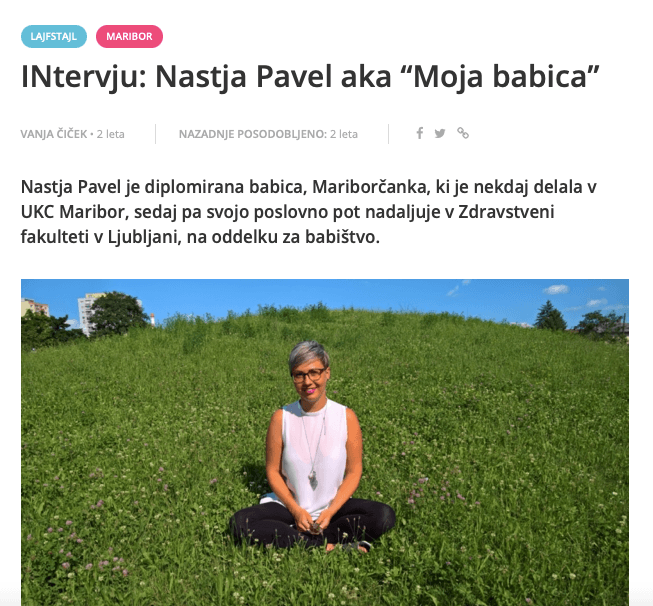
Nastja Pavel, also known as “Moja babica” (My Midwife), is a popular young midwife with a Master’s degree in Health Sciences who has helped countless women before and during childbirth. She is a woman who lives her profession, spending her free time giving advice to many pregnant women about this venerable period of their lives. Many women remember her as the always-smiling midwife who calmed down even the most nervous young mothers and pregnant women staying at UKC Maribor. She is now continuing her professional path elsewhere.
How stressful is your profession, really? I heard from the head of the department at UKC Maribor that there are definitely too few of you?
I am no longer employed at UKC Maribor. We hear about staff shortages in healthcare at every turn. Due to the conditions in healthcare, the extremely responsible work, and the three-shift schedule, the problem is that young midwives aren’t applying for job openings. And that is one part of the answer to the second part of the question. Most people imagine midwifery as a beautiful profession that brings new life – the birth of a child, a mother, and a father. However, in a system like ours (though quality indicators speak in favor of the care), it is much harder for a midwife to accompany a couple into parenthood.
Most of the time, the midwife doesn’t know the women and couples beforehand; she doesn’t know their lifestyle habits, expectations, fears, or past experiences. She has the extremely difficult task of gaining the couple’s trust in a short amount of time. At the same time, we have to realize that another woman in labor is waiting behind the next door, and another one behind the next.
At the counter, there’s a pile of documentation that needs to be filled out, and perhaps a colleague in one of the other rooms needs her help. Maybe in one of the rooms, she has a woman whose pregnancy didn’t end happily. Or the emergency bell rings because a woman is bleeding heavily and the lives of both mother and child are at stake. At the same time, she is probably tired because this is already her fourth night shift in a row. As wonderful as the midwifery profession is, it can also be very exhausting. And midwifery students must be prepared for this during their studies.
Are you perhaps an advocate for any ideas that aren’t yet implemented here?
Yes. Primarily, I advocate for “up to date” birthing practices and continuous midwifery care using the “one-on-one” model. This means that a woman has the opportunity to meet the midwife during pregnancy and vice versa, and that this same midwife accompanies her during childbirth. Ideally, even after birth, as continuous contact is essential for establishing trust and is a prerequisite for a good birth experience. It has been proven that a midwife-led model is the best choice for low-risk women. You can read more about continuous care here.
Why do I highlight low-risk women? Because midwives are responsible for them based on our competencies; otherwise, they must be managed by a doctor. You can read more here about the professional competencies of midwives.
How does the role of a midwife during birth actually differ from that of an obstetrician?
As I mentioned, the midwife is responsible for the woman during birth when everything is proceeding normally. Otherwise, an obstetrician-gynecologist also gets involved. For example, if the woman needs or wants medication, if it turns out that an operative delivery is necessary, if there is an injury to the birth canal that requires stitching, if postpartum hemorrhage occurs, and so on.
The English term “midwife” means “with woman.” So the essential task of a midwife is to be with the woman (at birth). However, as we’ve already established, this is often mission impossible. But we are all there for the woman, for the couple, for the family. So that is what we have in common.
How do you rate the “endurance” of Maribor women during birth? Do you happen to know the statistics for complications and C-section rates compared to Europe?
I wouldn’t focus on the “endurance of Maribor women” or women from other regions. I believe that the perception of labor pain and childbirth has changed over the years, influenced by changes in birthing practices and lifestyle. I also believe that human values have changed, which could have its own impact.
I don’t have the exact statistical data for the past year. The NIJZ has released data for 2015 and 2016, stating that the upward trend of children born by C-section continues. This means that every fifth child is born by C-section, which is still lower than the EU average. The World Health Organization has also issued recommendations regarding C-sections. A C-section is a surgical procedure. It is effective and saves the lives of women and children, so it is performed when there are medical reasons for it. The WHO recommends that the C-section rate should be around 10%.
What factors influence the need for a C-section?
I believe we can’t just look at C-section statistics. First and foremost, we have to look at what kind of population we have. NIJZ data from 2016 says that obesity and diabetes are on the rise as risk factors for cardiovascular diseases.
And if we have a pregnant woman with obesity, she also has a higher probability of pregnancy complications, such as high blood pressure during pregnancy, gestational diabetes, or premature birth. Then we have smokers, and women who must be managed in a tertiary center (Ljubljana or Maribor) due to previously known illnesses. All of this affects the statistics for complications and the performance of operative deliveries via C-section. So first, we have to take care of having a healthy population.
What kind of experience did you gain while working at UKC Maribor? Do you have any secret wishes for how you would set up your work?
The work was extremely educational; I gained a lot of experience, met great people, and have many wonderful birth stories. Many women still stop me on the street today and, with a smile on their faces, show me their toddlers, who will soon be first-graders. I keep all the letters and thank-you notes I’ve received. UKC Maribor is a tertiary center where you can see a lot of pathology, so a few difficult stories will always stay with me. Working at UKC Maribor was definitely an important experience that I would recommend to every young midwife, regardless of where her path takes her.
How much of it is actually in the head? I’m asking in the sense of whether a woman’s psyche during birth can influence things to the point where complications occur?
It can. That’s why it’s important to have people you trust by your side. That’s why I advocate for continuous midwifery care.
Can you list some practices that you might not agree with most, but are still being carried out? Would you change anything in the modern way of providing assistance during a woman’s labor? For example, many women in labor don’t agree with lying down during birth; they would rather squat so that gravity can do its work…
Practices vary from maternity hospital to maternity hospital. Factors that influence the “birthing practice” for an individual woman include the course of the pregnancy, the start and course of labor, the woman’s physical and mental preparedness, and the support she has during birth. That’s why we say every birth is a story of its own. With gravity, not everything is black and white. It’s necessary to listen to your body, take the factors mentioned above into account, and have proper guidance on when to work with gravity and when it’s better to choose rest and relaxation.
With gravity, not everything is black and white.
Which aspects would you highlight where we in Slovenia are worse/better than other EU countries in terms of practice, staff, hospital equipment, and finances?
That’s a difficult question to answer, as I mentioned before that birthing practices vary from maternity hospital to maternity hospital. This year, a project called “Moja porodnišnica” (My Maternity Hospital) was carried out, which can be found online. It consists of short presentation videos of all 14 maternity hospitals in Slovenia. This gives us an insight into their equipment, practices, and introduces some of the staff.
I can say, however, that women in Slovenia have ten preventive check-ups with individual counseling and two ultrasound examinations during pregnancy. They are provided with free preparation for childbirth and parenthood within maternity hospitals and health centers. There are visits from the community nursing service – one preventive visit during pregnancy, two visits for the mother after birth, and six visits for the infant in the first year of age. We have two tertiary centers, Ljubljana and Maribor, and 12 other maternity hospitals.
Most contraception is still free. Let’s not forget screening tests like ZORA and DORA. Regarding social welfare, I should mention paid maternity and paternity leave, which is very important for the bonding of the new family. All of these can be considered advantages.
So, since when have you no longer been working at UKC Maribor? You said you are away a lot. Can pregnant women call you for advice and for the support of “Moja babica”?
My work is still related to midwifery, but in a different way. Since December 2017, I have been employed at the Faculty of Health Sciences, University of Ljubljana, in the midwifery department. In addition, within my time constraints, I manage the website Moja babica, where readers can find plenty of advice on pregnancy, birth, the postpartum period, and midwifery.
What do you do in your free time? Where in Maribor do you like to go most?
Working with people is wonderful, but anyone who works with people knows it’s demanding. And when you’re a midwife, you’re a midwife 24/7. I carry out my mission 100%. Due to the current nature of my work, I’m on the road a lot, so in my free time, I prefer to be at home. I like cycling and going on trips into nature.
You are known by the “nickname” Moja babica. So it’s a sort of private business path. Where did the idea come from, and what is it about?
I don’t really know if it’s a business path. It’s certainly an additional path I’ve chosen in life. The idea was born shortly after I finished my degree in 2012. At that time, I didn’t get a job right away, but I didn’t want to “fall out of the loop.” At first, it was very modest. Just a social media profile where I shared an article here and there and summarized it a bit in Slovenian. I went with the flow, and interest kept growing. Of course, I worked hard in the meantime, and now I’m proud of what can be seen under “Moja babica.” It’s a “state of mind.” It’s a recognized, exclusive brand that I hope and wish will continue to grow strong roots with a beautiful flower. And even though I’ve been away a bit lately, all the content on the website www.mojababica.si is freely accessible at all times.
Who is your biggest idol?
In a professional sense, I don’t have one. Otherwise, my idols come from my private life. They are the fuel for my engine that drives me both professionally and privately. With them, every path is easier.
What has turned out to be the best advice you’ve given to pregnant women or women in labor? “Calm down” probably doesn’t work?
For this answer, I’ll use the words of a friend: “Advice is meant for each individual and cannot be universal. And you find the right words for everyone, at the right moment, especially when it really counts.”