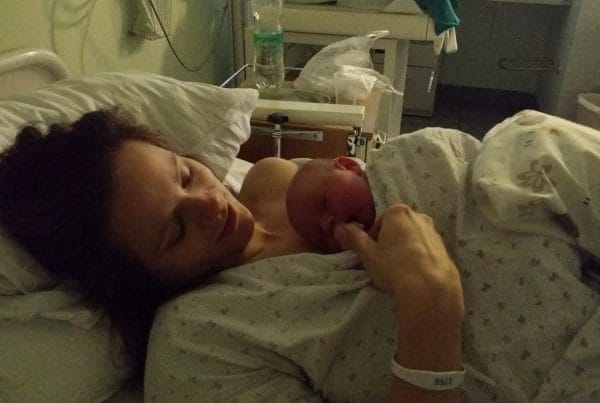
A pregnancy can also end tragically. Or a child may pass away a little later after birth. There are no words that could comfort the family. But death is part of all of this. Part of pregnancy, part of giving birth, part of life. I’m sorry for all of you, young souls who left too soon. And I’m sorry for all the parents, relatives, and friends who had to face this loss (too) soon.
Interview with me for Oopsi: About babies who never cried
“About babies who never cried”
This is a topic that is still talked about very little here. Somehow it feels like we Slovenians are still too closed off and find it hard to express our emotions, even though many a mum who finds herself in this situation might want to pour out all her grief at the top of her lungs. I spoke about babies who never cried with certified midwife Nastja Pavel, who shared with me how she feels when she helps bring a stillborn baby into the world.
A midwife’s work can be compared to art. In her work she has to use every skill, be intuitive, have a feel for others, be energetic and decisive. “To do the job well and connect the dots, you need a broad range of knowledge. The work is dynamic. No woman is the same as another, no case is the same as the next. With every woman/couple/family you grow and learn. Why did I choose this profession… well, I’d say because at the career info day the midwifery profession was presented really well, and I thought, that’s so cool, I want to become a midwife. Midwives really are cool, and above all because I’ve always wanted to work with people.”
There’s nothing like hearing a newborn’s first cry, right? I was curious what it feels like to be part of that magical moment, when you help bring new life into the world. “Every single time I get goosebumps and can’t believe I witnessed a new birth. You’re actually the baby’s first touch. And every time I hold them in my hands, these little beings, every time I say to myself—just a moment ago you were still in mum’s tummy. It’s as if I still can’t believe this miracle of nature. And I can’t say that “I” am the one who brings new life into the world. That’s the mother. And I don’t want to take that right and that praise away from her. And yet, being present and helping in the process of birth is a wonderful feeling.”
Sadly, many pregnancies also end tragically. The Slovenian Perinatal Information System for 2010 reports 100 stillborn babies in Slovenia. 6% died during birth, the rest before birth. “I don’t have newer statistics. Every single one is too many.”
I often wondered why it happens that a baby dies in the womb. Nastja told me: “A fetus can die at any time during pregnancy. Before the 22nd week of pregnancy we talk about miscarriage; after the 22nd week we talk about intrauterine death. There can be several causes, and sometimes the death remains unexplained. It can be due to conditions in the mother (infections, preeclampsia, HELLP syndrome, poorly controlled diabetes, etc.), it can be due to the fetus (congenital anomalies, genetic abnormalities, infections such as cytomegalovirus, for example), it can be a placental cause (placental abruption—premature separation of the placenta, fetomaternal hemorrhage, umbilical cord issues…). Risk factors also include maternal age, obesity, and maternal infertility. There can be many causes, but sometimes parents are left without an answer. In fact, they manage to determine a specific cause of death in only 1/3 of cases.”
The feelings when a stillborn baby is born can’t be described, says Nastja. “A gynecologist has to confirm the death by ultrasound. And when you’re standing there, looking at the ultrasound and you know something should be beating there, you’re left breathless. I think in that moment words are unnecessary, and a hand squeeze and a hug mean more. But you can also meet the woman in the delivery room. I can’t say what is harder. Encouraging a woman through labor when you know that in the end you won’t hear a baby’s cry is hard. So I think empathy plays a big role here.”
Parents’ reactions to the birth of a stillborn baby vary. Usually, the most immediate reaction to a child’s death is shock—it includes numbness, confusion, disbelief, and various feelings of unreality. “ We can say it’s a kind of protection from reality. In mums it’s more pronounced, which is why they cry later. I also see that fathers cry sooner. This is the reaction I notice most often. The next reaction can be denial, not accepting reality. The consequences of a child’s death are enormous, so parents truly need professional support in the grieving process. Support for themselves as individuals, support for them as a couple, and more broadly for the whole family. With appropriate support, the risk of adverse outcomes is reduced. The first contact is usually with doctors, midwives, and nurses, who are here to support and help them. Then a clinical psychologist, and if needed a social worker is also involved. It’s right that after the birth we encourage couples to look at the baby, hold them, name them, and take photos. They need to be given the time they need to say goodbye, even if it’s all so quick and far too soon. To tell the baby what they need to say. And they usually do.”
In Maribor, parents have the option of a group burial at the Field of White Roses, or an individual funeral in a coffin or urn. “It’s hard, because there’s also all the bureaucracy. For us as well as for them. You encourage them to seek the help they need, because they will need it. Even if they hold up well in the maternity hospital, it becomes so much harder once they leave. And here I think they need a lot of help and support from family and friends who will understand them, listen to them, and stand by them. Seneca, the Roman philosopher, said: “We do not fear death, but the thought of death.” Death still remains a taboo topic. And when we talk about the death of newborns and children, the topic is even more painful. In all these cases I would say once again: empathy, empathy, empathy.”
To all of you facing a tragic loss, midwife Nastja Pavel recommends the book Empty Cradle, Broken Heart. Even though this pain probably never fully heals, it might make it a little easier for someone, at least for a moment.
You can read a true story of a mum who went through this terrible loss here”
Mums for mums (loss; articles about loss and stories)
Time for Manca Košir – a conversation about death