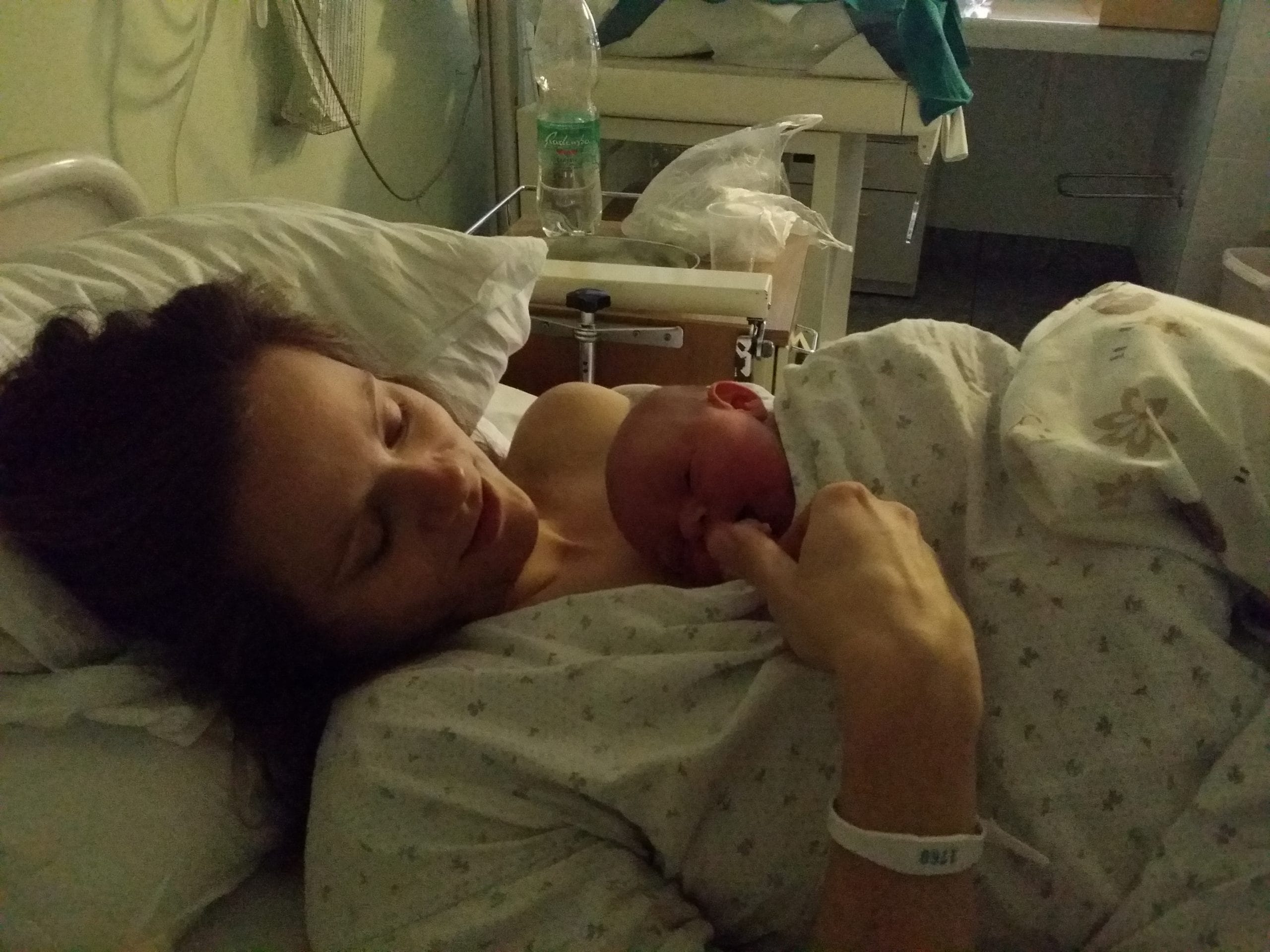
We are far too unaware of how important the undisturbed first hour after birth is. Without all the routine hospital procedures, such as weighing the baby, measuring length and head circumference, umbilical cord care, sometimes administering vitamin K in the delivery room (unless during skin-to-skin contact), and applying eye drops. All of this can wait at least one hour after birth when we’re talking about a healthy, full-term baby. The baby won’t grow during this time, nor will it shrink. If we’re lucky, the baby will pass the first urine and meconium. This will give us a more realistic birth weight. The first hour after birth is one of the most critical moments in life.
Odent (2002) presents the first hour after birth from 12 perspectives. The baby must breathe and the heart must pump enough blood for pulmonary circulation. In a calm environment where the mother feels safe, the right level of hormones will be released, and within the hour after birth, the baby’s hormones will also balance. After birth, the baby secretes noradrenaline. This helps the baby adapt to physiological oxygen deficiency. Due to this hormone, the baby has open eyes and dilated pupils. This eye contact helps mothers with bonding. Because of this, the hormones present during birth are also interesting from an etiological perspective—researching causes and phenomena. The first hour after birth is also important for establishing breastfeeding. With the kangaroo method, the baby will find the breast on its own. In the first hour after birth, the newborn also metabolically adapts to life, for example, by regulating blood sugar.
With birth, the newborn enters the “world of microbes,” so it makes sense for colonization to occur. And since mother and baby have the same antibodies (IgG), it makes sense and is the only right thing for the baby to be colonized with her bacteria (therefore, it’s not problematic for the mother to touch the baby during crowning). If we add to this the consumption of colostrum, which creates ideal intestinal flora for the newborn, we truly see that the first hour after birth is a critical period with lasting consequences from a bacteriological perspective (Richardson 1997, Odent 2002, Newman, 2009).
The newborn already feels the difference in temperature in the first minute after birth. Immediately after birth, the baby cannot yet regulate and maintain body temperature (Odent, 2002). The mother’s breasts are thus a natural thermoregulator that maintains optimal body temperature for the baby (Richardson, 1997). We must know that a hot shower, bath, or epidural analgesia can affect this physiological process. In the first hour after birth, the baby gets used to gravity. Numerous rituals of cultural origin, such as immediate cutting of the umbilical cord, ear piercing for girls, bathing the newborn, swaddling the baby, and others, can disrupt the first contact after birth. Thus, the ethnological approach to the first hour after birth is extremely important (Odent, 2002).
With an uninterrupted first hour after birth and the kangaroo method, we can do a great deal for the benefit of the mother and newborn. The baby has a stable heart rhythm (without bradycardia), the possibility of apnea is reduced by 75%, as the depth of each breath becomes more stable (if they do occur, the duration decreases with each episode), saturation improves, sleep periods are longer, weight gain is faster since the baby doesn’t lose extra energy maintaining body temperature, blood sugar levels stabilize as does blood pressure. Brain development is faster, the baby cries less and experiences fewer stressful stimuli, breastfeeding is more successful, discharge from the maternity ward is quicker. These babies are more often exclusively breastfed. With the kangaroo method in the delivery room, we ensure early bonding, parents gain confidence in themselves that they know how to care for their baby, they gain confidence that their baby is well cared for, and a feeling that they have things under control. It has been proven that this method has no short-term or long-term negative consequences (Moore, Anderson, Bergman, Dowswell, 2012). So we wipe the baby immediately after birth to dry them and place them vertically on the mother’s abdomen. The baby will find the way to the breast on their own, and even if they don’t nurse within two hours, this shouldn’t worry us. There are so many other benefits to skin-to-skin contact that we can give them time in the first hour after birth (Newman, 2009, Stevens, Schmied, Burns, Dahlen, 2014).
The fourth step of the “10 Steps to Successful Breastfeeding” requires maternity wards with the designation “Baby-Friendly Hospital” to place the newborn immediately after birth in skin-to-skin contact with the mother for at least one hour and encourage mothers to observe their babies’ readiness to breastfeed and offer them help if needed (Unicef, 2013). Even with a cesarean section, there is no reason not to allow skin-to-skin contact while the surgical wound is being sutured. This way, we can also enable mothers with cesarean sections who are not under general anesthesia to have immediate bonding and faster establishment of breastfeeding, and give the baby all the positive effects of skin-to-skin contact after birth and that calm first hour after birth that they need (Newman, 2009). If the mother is under general anesthesia, we place the newborn on the father’s chest.
It’s understandable that thinking about the third stage of labor from a non-medical perspective causes uncomfortable feelings for many people, especially doctors. But despite this, it’s advisable to review studies, use basic knowledge of anatomy and physiology, and include experience so that our guidelines are shaped best for newborns, mothers, and healthcare workers. If we stick only to studies, we need to take into account that they can be politically incorrect (Odent, 2002).
Uninterrupted skin-to-skin contact between the newborn and mother does not affect our work, such as immediate placement of the identification bracelet, monitoring postpartum bleeding, cutting the umbilical cord, and care of any birth canal injury. If we do this without separating the newborn and mother, it will be less stressful for them. During this time, we can complete documentation. We can wait with measurements of the newborn and other procedures and interventions that are not urgent until this important first hour after birth has passed. If there was an injury to the birth canal during delivery that needs to be treated immediately, let the mother have the baby on her chest, unless she herself wishes otherwise or her health condition prevents it. Perhaps implementing this practice requires only a small reorganization of current habits and arrangements within maternity ward departments.
Mothers’ experiences:
“I’m most grateful that breastfeeding worked out for us, and I’m convinced that a big part of why this is so can be attributed to that first contact (with my first son, this wasn’t made possible for me, breastfeeding never worked out for us, so I pumped milk for almost a year).” – Nuša, 2016
“You helped us get breastfeeding started and took photos of us and helped create our first shared memories. I’m glad I could have you by my side, even though it was a short time, but most importantly, you were with me at the most important time! You were at the right place at the right time. Thank you.” – Eva, 2016
From 2016:

Read also:
- Bonding between mother and baby after a C-section
- Parenthood and bonding
- The newborn’s 9 instinctive stages
- Fear of childbirth
- First newborn care after birth – bathing
- Breastfeeding in the delivery room
- Birth plan
- Cutting the umbilical cord
- Postpartum plan
https://www.facebook.com/notes/moja-babica/9-instiktivnih-faz-pri-novorojencu-prva-ura-po-porodu/552404774913873 9 instinctive phases in the newborn
http://www.unboundmedicine.com/medl… Skin-to-skin contact. Part one: just an hour of your time…
http://www.unboundmedicine.com/medl… Skin-to-skin contact. Part two: the evidence.
http://wisewomanwayofbirth.com/skin-to-skin-above-all-else/ Skin to skin above all else
https://www.facebook.com/notes/moja… 5 Ps for a better birth experience
http://mybabysheartbeatbear.com/blog/the-golden-hour-after-birth/ The golden hour after birth
https://www.sciencenews.org/blog/growth-curve/timeline-baby’s-first-hour Timeline baby’s first hour
http://www.homegrownbabies.com/2016/03/the-first-72-hours-postpartum/ The 72 hours postpartum
http://www.gmanetwork.com/news/story/448061/lifestyle/healthandwellness/watch-who-campaign-stresses-importance-of-first-embrace-between-mom-newborn Watch WHO campaign stresses importance of first embrace between mom and newborn