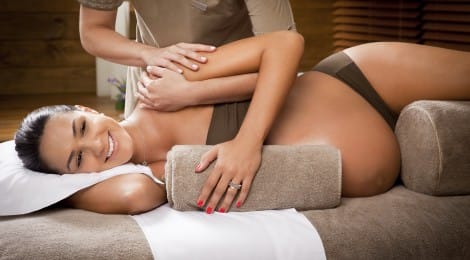
Massage during pregnancy can help, but the massage therapist must be aware that they are massaging two people and therefore exercise greater caution and gentleness. The area around the abdomen should be avoided, especially in the first trimester (Lacroix et al., 2007).
Lacroix and colleagues (2007) describe that a woman who does not have high blood pressure during pregnancy, does not have significant water retention in her body, and does not have swollen legs and arms, can receive massage with oils that reduce nausea, stretch marks, relieve stress, and ease pressure on joints and muscles. Essential oils of mandarin and neroli, geranium, and frankincense in a vegetable carrier oil enriched with wheat germ and carrot oil are used against stretch marks. To relieve lower back tension, the oil can be spread over the lower back and buttocks with stroking, followed by massage of the buttock muscles. The pregnant woman can place her hands on her lower back. Rubbing the oil in small circles with the fingertips is even more effective, as it reduces muscle tension, while the other hand pushes the tissue toward the fingers that are massaging. If the first trimester passes without problems, the abdomen can be massaged gently with the same circular movements normally used for abdominal massage when performing a full-body massage (Lacroix et al., 2007).
Touch represents a profound sensory experience. If a woman massages herself daily, she can activate many nerve receptors responsible for regulating bodily functions. During pregnancy, a woman can do a lot to prepare the perineum for childbirth and increase its elasticity. Midwives who use aromatherapy in their work have found that episiotomy or perineal tearing occurred in forty-eight percent of women who performed perineal massage, compared to seventy-seven percent of women who did not perform the massage (Merlene, 1994).
To achieve optimal results, the perineum should be massaged for five to ten minutes daily, five to six weeks before the expected due date. Before the massage, the bladder must be emptied, followed by five to fifteen minutes of warming water with added lavender oil to create a bath that relaxes the vaginal muscles. After washing your hands thoroughly, insert your thumb and index finger into the vagina deep enough to stretch the perineal area, pressing toward the vaginal walls and back toward the rectum. The massage is performed in a U-shape with a mixture of three drops of lavender, one drop of geranium, and one drop of wheat germ oil, then hold the vagina open for twenty to sixty seconds until there is a burning sensation similar to when the baby’s head crowns. Over time, the perineum becomes softer (Merlene, 1994).
Benefits of Massage
are felt not only by the person being massaged, but also relax both the giver and the receiver (Lacroix, 1996). Maxwell Hudson (1988) wrote that massage improves blood circulation, relaxes muscles, stimulates digestion, and by stimulating the lymphatic system accelerates the elimination of waste products. These direct benefits, combined with psychological ones (the feeling that someone cares for us and pampers us), immediately create a sense of well-being, which cannot be claimed for medications.
Massage slows the heartbeat, relaxes muscles, lowers the level of stress hormones (adrenaline and cortisol, which are associated with numerous diseases), increases the level of serotonin and dopamine, which help control pain, and strengthens the immune system. Not only does massage have beneficial effects against back pain, headaches, and contribute to better sleep, but it also has beneficial effects against other problems caused by cancer, fibromyalgia, autoimmune diseases, and also relieves pain that occurs after surgical procedures (Massage therapy: the healing touch, 2005).
Ellsworth and Altman (2014) listed several additional problems that can be alleviated or resolved with massage therapy. These are allergies, anxiety and fear, arthritis (osteoarthritis and rheumatoid arthritis), asthma, bronchitis, carpal tunnel syndrome. We can also resolve or alleviate back and shoulder pain, depression, fibromyalgia, insomnia, sinusitis, sports injuries, and tension headaches.
Therapeutic massage has numerous positive qualities, as it contributes to better mental well-being, promotes calmness, and reduces anxiety. Through touch, massage establishes a special bond between the person being massaged and the massage therapist. Jensen and colleagues (2012) conducted a study in which they examined the effect of massage on the mental state of the massage therapist. The study included 22 volunteers, mentally and physically healthy women and men, aged between 18 and 65 years. The subjects were divided into two groups. People from the first group performed a one-hour Swedish massage, while people from the second group were directed to a room where they performed normal, everyday activities. After completing the activity, they answered the DASS questionnaire (Depression Anxiety and Stress Scale). They found that people who performed a one-hour Swedish massage had a lower level of anxiety compared to those who performed everyday activities (Jensen et al., 2012).
Contraindications for Massage
Although massage is beneficial, in some cases we should not choose it. Without a doctor’s permission, we do not massage a person suffering from high fever or skin diseases, swelling, unknown lumps, inflammation or severe injuries, fresh scars, fresh and open wounds, inflammation or varicose veins, acute back pain, cardiovascular diseases such as thrombosis or heart disease, cancer, epilepsy, AIDS, or any mental illness (Lacroix, 1996).
Sabati Šuster (2008) advises that pregnant women should only be massaged after consulting with a doctor. Maxwell Hudson (1988) wrote that careful, gentle massage benefits every pregnant woman.
Although massage is considered an extremely relaxing complementary therapy, it is not entirely without risk. Therefore, special measures and contraindications must be observed when massaging during pregnancy: in the first trimester for sacral and suprapubic massage; throughout pregnancy for vigorous massage of the feet in the reflexology area for the pelvic region; contraindicated are also acupressure points bladder 21, large intestine 4, and gallbladder 6. Massage of the abdomen is also contraindicated if there has been previous bleeding. Caution is needed in case of any previous health problems (Tiran 2004, cited in Tiran 2009).

Pressure Points (Lidell et al., 1990)
Most Common Problems During Pregnancy
Most physical changes during pregnancy are pleasant, said Deans et al (2006), but they also emphasize that some changes may occur that are not so pleasant.
The most common problems are fatigue, morning sickness, stress incontinence, dizziness and fainting, hemorrhoids, excessive salivation, heartburn, gas and bloating, shortness of breath, insomnia, varicose veins, fluid retention and swelling, constipation, leg cramps (which become more frequent and more painful as pregnancy progresses), and back pain (experienced by at least half to three-quarters of pregnant women) (Deans et al, 2006).
Back pain is the most common problem during pregnancy, but back massage can largely eliminate it, notes Maxwell Hudson (1988). Therefore, in the next section, the author focuses only on back pain.
During the first trimester, lower back pain occurs more frequently because hormones begin to be released that make the pelvic ligaments more flexible (Keating et al., 2013). Back pain is one of the most common pregnancy problems. Mild pain can begin immediately with conception and continue throughout pregnancy due to physical inactivity or fetal position, excessively high levels of the hormone relaxin, changes in the body’s center of gravity, previously existing lumbar curvature, vascular effects, fluid retention in the body, direct pressure of the enlarged uterus on nerve roots, epidural analgesia in previous pregnancies, multiple pregnancy and older age of the pregnant woman, physically demanding work during pregnancy, smoking, oral contraception, or biomedical-assisted fertilization (Šćepanović, 2003). Some women describe back pain as a negative and exhausting experience. Melzack and Belanger (1989) conducted a study in which they wanted to determine whether back pain during pregnancy is an indicator of back pain during labor. Using the Short-Form McGill Pain Questionnaire (SF-MPQ), they interviewed 114 women the day after delivery and found that back pain during pregnancy was not influenced by back pain before pregnancy. However, they found that there was a connection between menstrual back pain and pain during labor. Fast and colleagues (1987) came to the realization, after interviewing 200 women 24-36 hours after delivery, that as many as 56% of women suffered from back pain during pregnancy and that it was not related to the age of the pregnant woman, weight gain during pregnancy, the weight of the newborn, or the number of pregnancies. What most interviewees had in common was that the pain began to appear between the fifth and seventh month of pregnancy. Ostgaard and colleagues (1991), who studied back pain in 855 women from the 12th week of pregnancy to delivery, found that back problems before pregnancy increase the risk of back pain during pregnancy, just as age, previous pregnancies, and various physical and psychological factors are also important. Relief from discomfort can be achieved non-pharmacologically.
Advice on complementary methods for relieving pregnancy problems is especially welcome for women who do not want to resort to pharmacological means (Adams, 2012). Two studies even confirmed that pregnant women who received massage for several weeks, starting from the second trimester of pregnancy, had less back and leg pain and fewer complications during delivery than other women (premature birth and low birth weight of the child). According to research, massage during labor itself helps reduce pain and stress (Massage therapy: the healing touch, 2005).
Full-Body Massage – Adapted for Pregnant Women
Massage is the simplest and most natural form of pain relief (Berginc Šormaz and Šormaz, 1998). Deans et al (2006) advise avoiding massage in the first trimester and immediately stopping the massage if the pregnant woman experiences any discomfort. She also wrote that it is best for the pregnant woman to be massaged by the person who will be with her during labor, as they will know which parts are tense or stressed and which massage is most effective.
The basic sequence for massage follows from the back to the back of the legs to the shoulders, neck, and scalp. This is followed by the arms, chest and abdomen, and the front of the legs (Lidell et al., 1990).
Shoulders and Neck
The massage therapist symmetrically and gently kneads the back of the shoulders with both hands. The massage continues with the thumbs along the spine slowly upward. The back of the shoulders is then gently chopped (Berginc Šormaz and Šormaz, 1998). Sabati Šuster (2008) advises stroking the muscles from the edge of the scalp toward the shoulders, then soft stroking along the spine toward the buttocks and kneading the shoulder muscles.
Lower Back and Buttocks
The pregnant woman lies on her side. The massage therapist massages her lower back with their fingers, then kneads the buttock muscles. The pregnant woman actively helps during the massage by saying what feels good (Berginc Šormaz and Šormaz, 1998). Sabati Šuster (2008) warns that the massage therapist massages only the muscles and avoids the spine. The massage therapist uses the stroking technique; with the fingertips of both hands, they slowly push the muscles apart (Sabati Šuster, 2008).
Back Massage
Deans et al (2006) advise that the pregnant woman should kneel on a pile of cushions on the floor or on the bed to support the abdomen and head. The partner or the person massaging places the palm of their left hand on the pregnant woman’s left shoulder during the massage. They massage the left side of the back firmly and slowly, going lower and lower to the buttocks. Before removing the hand on the left side, they already begin on the right. They switch hands several times. Then they use their thumbs, making soft circular movements in the grooves on both sides of the spine, moving slowly downward, vertebra by vertebra. Toward the end of the back, they make larger circular movements with their palms and move them across the hips.
In the last trimester, the technique of massaging one’s own back is effective. The pregnant woman can massage her lower back herself by forming fists and placing them on the painful spot. She then moves the fists up and down and left and right. She does this for about 5 minutes or as long as it is still pleasant (Keating et al., 2013).
Deans et al (2006) write that pregnant women often enjoy foot massage, so it is good to start practicing early. The pregnant woman sits on a chair and places her leg on a cushion on a footstool. The partner or the person massaging kneels in front of her. The heel rests in their palm, and with the other hand they firmly massage from the ankles to the toes. The massage is repeated slowly and evenly for several minutes. They massage between individual toes with their finger. Then they bend the toes upward and place the heel on the cushion of the footstool. With small circular movements, they massage the sole. With appropriate pressure, this should not tickle. The partner or massage therapist grabs the ankle, lifts the foot, and starts massaging again from the ankle toward the toes.
Stimulating points on the outside of the foot should be avoided, as such activity can trigger premature labor (Keating et al., 2013).
Since pregnant women often experience leg cramps and leg swelling, Turkish researchers wanted to determine what effect foot massage has against this discomfort. The study included 80 pregnant women who were randomly divided into two groups. While the experimental group of women received foot massage, the control group was given only regular prenatal care. After massaging the feet of pregnant women in the experimental group for 20 minutes for five days, they found that the leg circumference was significantly reduced compared to the other group of women. Thus, they came to the realization that foot massage helps reduce swollen feet (Çoban and Sirin, 2010).
Abdominal Massage
Furlan (2012) states that a pregnant woman can massage her abdomen herself or her partner can help her. The massage can be performed sitting, standing, lying on her side, or sitting on a ball, clothed or with a bare abdomen, with oil or without it. During pregnancy, this can help establish contact with the baby, and it is also beneficial during labor, as the woman in labor breathes more deeply due to the massage and thus takes her mind off the pain. The massage also calms the baby.
The massage therapist covers the ball with a soft towel and uses it to relax the pregnant woman’s hands. They massage in a clockwise direction, following the course of the intestines. They move their hands from the abdomen across the hips and back from the back across the hips to the abdomen (Furlan, 2012).
All stroking techniques can be used, but always gently. Any pressing and hitting should be avoided (Maxwell Hudson, 1988).
Exceptional experts in head massage are Indian women, who wanted to relieve tension in the scalp and maintain thick and healthy hair. Head massage has been known in India for more than 1,000 years, and they always start by placing their palms on the head. Before they start massaging, they relax well and get into the rhythm of the person’s breathing. This is followed by gentle circular movement of the fingers and thumbs on the scalp with a gradual increase in pressure. With even greater pressure, they massage the temples. Then they use the techniques of ruffling or pulling hair, so that the hands are shaped like the letter C, with the fingers then pulling and lifting the hair in a zigzag motion. It ends with pushing the hair away from the face. This massage calms the mind and relieves headaches, relaxes and relieves tension, stress, and anxiety (Keating et al., 2013).
The effect of massage is enhanced by combining and using essential oils. In the next chapter, the author describes massage with essential oils during pregnancy.
Massage with Essential Oils During Pregnancy
Particularly careful use of essential oils is required for pregnant women. Caution is necessary when choosing the type of essential oil, which must not contain substances that stimulate menstruation and hormonal activity. These include essential oils of angelica, juniper, cinnamon, ginger, jasmine, marjoram, and clary sage. Due to the overly strong smell, rosemary oil should be avoided, which can only be used after the first six months of pregnancy, and even then in combination with an unscented carrier oil, usually almond, which does not contain more than half the amount of essential oil recommended in the recipe (Keating et al., 2013).
Essential oils that are recommended during pregnancy are from citrus fruits, geranium, chamomile, neroli, sandalwood, lavender, and rose. They differ from each other in color, effect, and smell. They can act on the body as antiseptic, antibiotic, soothing, or as an aphrodisiac. During pregnancy, it is recommended to choose a mixture of 50 ml of almond oil, 5 ml of wheat germ oil, 4 drops of lavender, 4 drops of sandalwood, 2 drops of mandarin, and 2 drops of geranium (Lees et al., 2010). Among these oils, lavender oil is considered one of the most universal essential oils. It goes particularly well with geranium, which is a light floral fragrance. Both types of oils are characterized by helping against anxiety and depression, as they calm and improve mood (Lacroix et al., 2007).
Postpartum massage is also highly recommended. In many places in the East, it is a tradition for the midwife to massage the new mother every day for 40 days after delivery. While massaging the entire body, she pays special attention to abdominal massage, which helps the abdomen shrink faster, pain disappears, relieves the strain of caring for the baby, and reduces nervous tension. Since the abdomen can be very sensitive, particularly careful massage is required.
Many thanks to Doris Strmšek (Srmšek), author of the thesis “Massage of Pregnant and Postpartum Women” 2015, under the mentorship of Assoc. Prof. Dr. Ana Polona Mivšek and co-mentorship of Assist. Petra Petročnik, MSc Midwifery (MSc UK), for permission to use her thesis for this article.
Source 2: Thesis by Erika Cuznar – Aromatherapy in Different Life Stages of Women and the Perinatal Period (2015) under the mentorship of: Senior Lecturer Teja Škodič Zakšek, BSc Radiography, BSc Midwifery, MSc UK