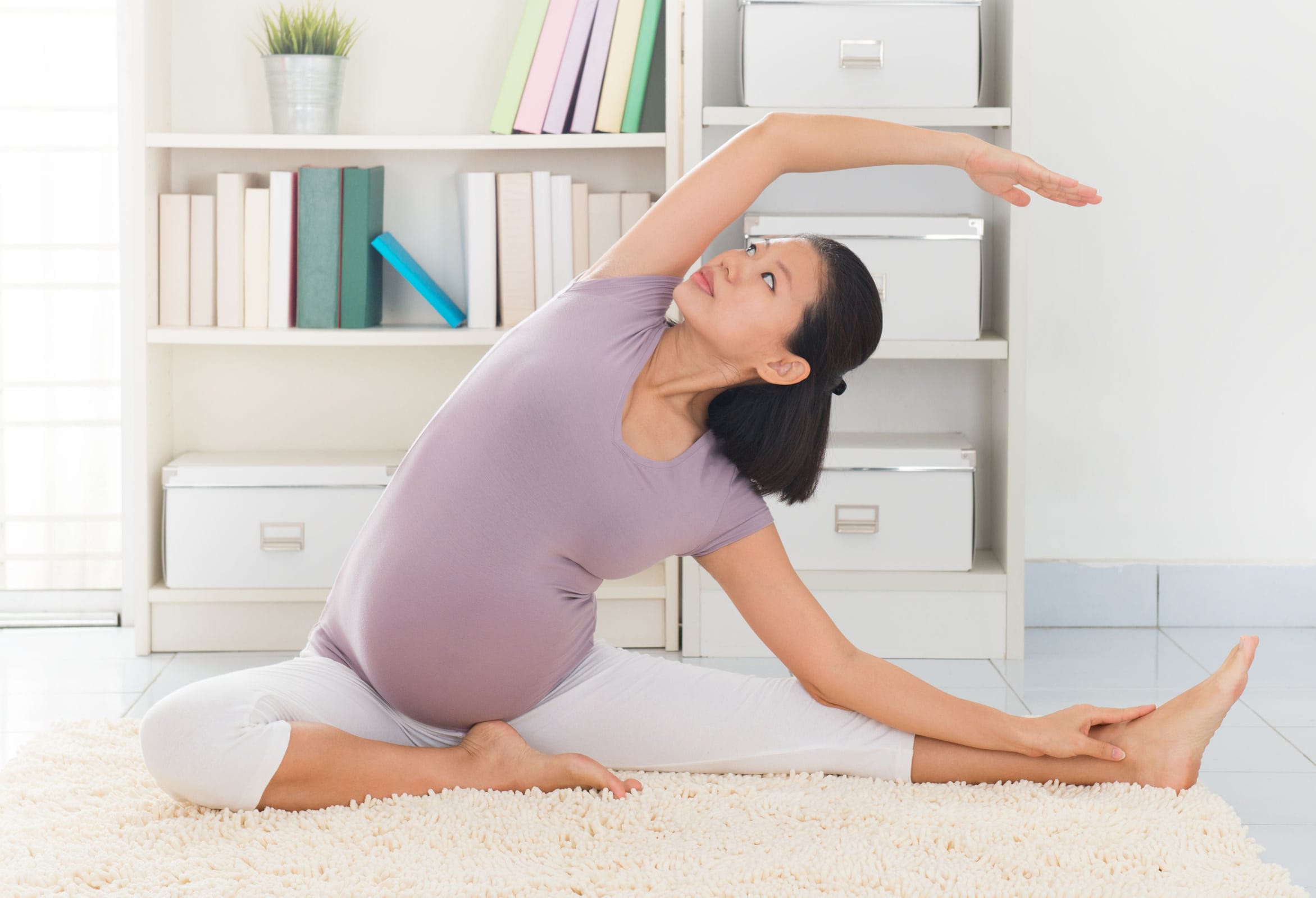
Pregnancy is a time of great physical and emotional changes, but physical activity and movement should remain a normal part of daily life. In 2002, the American College of Obstetricians and Gynecologists stated that 30 minutes or more of moderate physical activity per day, most days of the week, is recommended for pregnant women, provided there are no medical or other pregnancy-related complications. Moderate exercise means that the woman must breathe through her mouth rather than her nose but can still talk without difficulty (the so-called talk test) (Šćepanović, ND).
The goal of physical activity during pregnancy is to maintain or moderately improve physical fitness, and after childbirth, to restore and then improve fitness. Women have different levels of fitness before pregnancy. The levels of fitness they wish to achieve during pregnancy and after childbirth also vary from woman to woman. Therefore, it is necessary to give women a questionnaire before they start an exercise program (Šćepanović, ND).
During exercise, a pregnant woman should master:
- Correct activation of the deep abdominal muscle (transversus)
- Correct execution of pelvic floor muscle exercises
- Correct breathing
- Correct lifting of loads
- Correct standing up
- Correct posture
- Body position and functional patterns for effective bowel movements
- Learning to observe oneself
WHICH EXERCISE IS RECOMMENDED?

GENERAL EXERCISE RECOMMENDATIONS
- Before starting exercise, a pregnant woman should always warm up gradually and cool down after exercise.
- She should never exercise after a large meal (2 hours should pass between a heavy meal and the start of the physical exercise program). She should be careful not to have a completely empty stomach, as she would quickly become hungry during exercise and would not be able to exercise safely and successfully.
- She should not exercise in an extremely hot, cold, humid, or poorly ventilated room.
- She should not exercise if she has a fever or is acutely ill.
- She should use light, breathable clothing. Footwear should be comfortable and non-slip.
- She must replace fluids during exercise. She should drink a few sips of water or non-alcoholic, non-carbonated drinks.
- The type of exercise should be appropriately chosen. A pregnant woman should avoid learning new sports or risky sports. She should engage in exercise/sports she is already familiar with and has mastered.
- Exercise intensity should be appropriate for the pregnant woman’s fitness level, or such that she can still talk during exercise. It is important that she listens to her body. Moderately intense exercise is most recommended.
- Exercise duration should be around 45-60 minutes.
- The intensity and duration of exercise, as well as the weight of loads and the number of repetitions and sets, should be reduced as the pregnancy progresses.
- Heart rate should not exceed 140 beats/min or 60-70% of max heart rate.
- One day of rest is recommended between individual exercise sessions.
- She should avoid exercises with jumping and excessive strain on the abdominal muscles.
- She should be moderate and careful with stretching exercises.
- She should avoid ballistic exercises such as bouncing, sliding, rocking, and jerking.
- After the 16th week of pregnancy, she should avoid exercises where she lies on her back for more than 5 minutes at a time.
- Body position should be changed slowly, especially from a low to a high position and vice versa.
- If she has problems with involuntary urine leakage, pain in the spine, pelvis, or pubic symphysis, or a pathological separation of the rectus abdominis muscle, she should seek help from a gynecologist, who will refer her to a physiotherapist.
- If she is regularly physically active, she should consume an additional 200 to 300 kcal per day.
- She should never exercise alone or in a dangerous environment.
- She should be alert to warning signs to stop exercising.
- She should not hold her breath during exercises but should breathe steadily and relaxedly.
- She should pay attention to correct posture during exercise and daily tasks (Pogorevc 2012 after ACOG, 2002, RCOG, 2006; Drev and Drglin, 2010).

CONTRAINDICATIONS
Absolute contraindications:
- Elevated BP (preeclampsia)
- Fetal distress
- Threatened premature birth (shortened cervix)
- Placenta previa
- PROM (PPROM)
- Regular bleeding during the second and third trimesters
- Multiple pregnancy
- Uncontrolled Type 1 diabetes, thyroid disease, other serious cardiovascular, respiratory, or systemic diseases
- Acute infectious diseases
Relative contraindications:
- miscarriage or premature birth in previous pregnancies,
- twin pregnancy after week 28,
- eating disorders (anorexia, bulimia),
- chronic bronchitis
- IUGR
- anemia or iron deficiency (Hb <100 g/L),
- mild and moderate chronic cardiovascular and respiratory diseases (e.g., high blood pressure – but controlled, arrhythmias, bronchial asthma, and chronic bronchitis),
- extremely sedentary lifestyle,
- smoking (more than 20 cigarettes a day)
- orthopedic limitations,
- poorly controlled thyroid diseases,
- obesity,
- poor nutrition or eating disorders,
- poorly controlled seizures (ACOG, 2002; Kebler Zaletel, 2012).
When should you stop exercising?
- Vaginal bleeding
- Difficulty breathing at rest
- Dizziness and vertigo
- Headache, visual disturbances
- Back or pubic pain
- Kidney pain
- Vena cava syndrome
- Chest pain and heart palpitations
- Muscle weakness
- Calf pain or swelling
- Contractions
- Decreased fetal movement
- Leaking of amniotic fluid (ACOG, 2002).
FITT PRINCIPLE (frequency, intensity, time, type of exercise)
- Moderate-intensity activity, aerobic type
- Heart rate should not exceed 140 beats per minute or 60-70% of max heart rate
- Regular exercise 3-4x a week, lasting 25-60 minutes
- One day of rest is recommended between individual sessions
A pregnant woman should not exhaust herself; care must be taken that the exercise is not too intense. She should not get too out of breath and must be able to have a normal conversation during exercise. The surface for physical activity should be wooden or padded floors that reduce impact and provide reliable, non-slip support for the feet. Weather conditions should be taken into account (Kebler Zaletel, 2012)
Why should a pregnant woman be active?
- Maintaining good physical condition and flexible, firm, and strong muscles helps make pregnancy easier and allows for better and more active participation during childbirth.
- It reduces or alleviates pregnancy discomforts (edema, nausea, constipation, varicose veins, muscle cramps, BP issues, etc.) and helps regulate body weight, maintain correct posture, and prevent pain.
- It maintains and strengthens general fitness, joint mobility, elastic endurance, and muscle strength.
- It also positively affects fetal development.
- Faster return to pre-pregnancy figure.
Women learn (relaxation) breathing techniques, get to know their bodies and their response to positions better, and learn to tense some muscles while simultaneously relaxing others (Drev, Drglin, 2010)
Impact on the fetus
- Special attention to blood circulation during high-intensity exercise.
- During activity, the fetal heart rate increases to get more oxygen.
- During moderate activity, fetal movement temporarily increases, indicating the fetus is not in distress.
- Smaller weight gain (approx. 300g), which is still within normal limits.
CHARACTERISTICS OF A GOOD INSTRUCTOR
An appropriately qualified instructor safely guides a woman through exercise during pregnancy and takes appropriate action or provides advice in case of problems. Pregnant women attending group physical exercise sometimes do not know if the instructor has special knowledge related to pregnancy and exercise during pregnancy, and they cannot verify this. It is therefore worth noting the need to establish a mechanism to ensure that exercise for pregnant women is led only by an appropriately qualified instructor (Drev and Drglin, 2010).
The instructor must:
- understand and know all limitations related to risky and healthy pregnancies,
- be able to notice and assess changes and the pregnant woman’s abilities,
- distinguish beneficial from harmful exercise,
- stop exercise in a timely manner,
- be able to provide appropriate and specific advice, and perform and teach pregnant women various breathing techniques and relaxation methods
- prevent potential pain and injury, dehydration, overheating, and oxygen deficiency in the fetus,
- know ergonomic principles and correct postures and positions,
- safely and correctly distribute exercises for strength, endurance, and flexibility
- ensure that every pregnant woman feels safe, accepted, and relaxed.
- provide a questionnaire about your health status before starting the exercise program.
- perform a test for abdominal muscle separation,
- perform a test for pain.
A pregnant woman should not join programs for non-pregnant women. A program can be adapted for her by a professionally qualified aerobics instructor. If such an instructor is not available, she should participate in low-intensity groups and avoid lying on her back, jumping, and maximum stretching (Slovenc, 2009).
Pregnancy has long ceased to be just a state of childbirth and immobility; an active lifestyle during pregnancy is safe and beneficial. Most health and scientific organizations encourage physical activity at all stages of life, including pregnancy.
Read more: Diastasis recti